Online Roulette: Rules, Variants, Demo Play, and Real-Money Considerations

Last updated: 2026 | Reading time: about 20 minutes | 18+/21+ depending on jurisdiction

In short: online roulette is played on a wheel with 37 pockets (European and French) or 38 pockets (American). Bets split into inside and outside groups, plus racetrack (called) bets on advanced live tables. The wheel version, not the betting system, sets the house edge: 2.70% on European wheels, 5.26% on American, and roughly 1.35% on French even-money bets under La Partage. Demo mode uses virtual credits and carries no financial risk. Real-money play needs funding, identity verification, and limits you set before the first spin. Monte Carlo testing of dozens of progressions has repeatedly confirmed the same thing: no staking pattern moves expected value.

Three facts worth carrying into the lobby. First, every payout on the layout is calibrated to a 36-number wheel that physically holds 37 or 38 pockets, and that gap is the operator's margin. Second, table choice changes your expected cost far more than any roulette strategy ever will. Third, the biggest practical risks in real-money play are not rigged wheels but unlicensed operators, unread bonus terms, and sessions without an exit point. Keep those three in mind and most of the rest of this guide becomes easier to read.


Provider

Pragmatic Play

RTP

97.50%

Max win

15,525x

Online Roulette Rules, Variants, Demo Play

Foundations of Online Roulette

Roulette is the most recognisable wheel-based game of chance in the casino portfolio. It also translated to digital play more faithfully than almost any other table game. Understanding it properly means separating three layers: the physical architecture of the wheel and table, the rule set of the specific variant, and the mathematics of payouts relative to probability.

Defining Roulette as an Online Casino Game

Roulette is a banked game. Players wager against the house, not against each other, and outcomes settle at prescribed payout ratios rather than through player-to-player risk. That is why the operator's margin is structural. It sits in the mismatch between the payout on a winning number (35:1) and the true odds of hitting it (36:1 on a single-zero wheel).

«Every roulette bet is an event in a finite probability space; complex combinations raise hit frequency but never change expected return while a zero pocket exists.» — Venkatesh & Gomathi Bhavani (2023), mathematical model of European roulette.

That one sentence explains most of what beginners get wrong. Covering 30 numbers instead of one raises your hit rate dramatically and smooths your variance. Yet expected return per unit staked stays identical, because the payout table was built for 36 pockets and the wheel has 37 or 38. Modern online casinos reproduce that structure digitally, either through certified random number generators or through live video streams of physical wheels.

Wheel, Ball, Chips, and Table: Physical Architecture

Four components define the game:

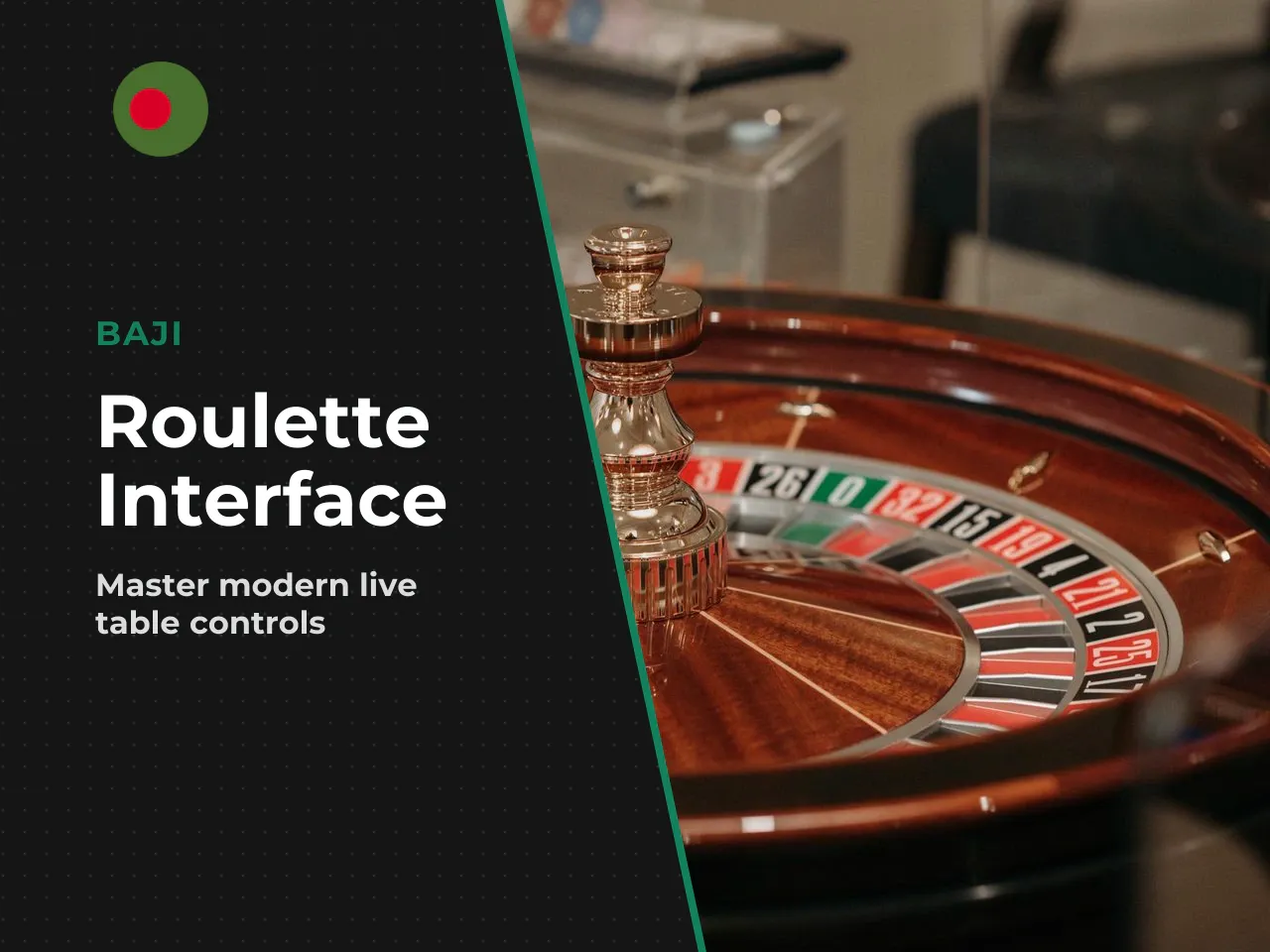
  • The wheel. A rotating disc with numbered pockets set around a metal rim. The single-zero roulette wheel carries 37 pockets (1 to 36 plus a green 0). The double-zero American wheel carries 38 pockets (1 to 36 plus green 0 and 00). Non-zero pockets alternate red and black; zero pockets are always green.
  • The ball (the pill in professional croupier vocabulary). The dealer releases it against the direction of the wheel's rotation. It decelerates, bounces across the deflectors, and settles in one pocket. That settlement is the outcome.
  • The chips. Wagers register when chips land on marked betting areas. In live play chips are denominated by value selectors; in RNG play they are digital tokens tied to your balance.
  • The table. The betting surface mirrors the wheel's numbers in a 3×12 grid. Outside-bet areas (red/black, odd/even, high/low, dozens, columns) sit around the perimeter, along with markers the dealer uses to flag the winning number. Advanced live tables add a racetrack, an oval map of the physical wheel sequence used for sector bets.
Wheel, Ball, Chips, and Table Physical
  • Type:Infographic, structure of the roulette table and wheel
  • Description:Labelled diagram of the key zones on the roulette wheel and roulette table: numbers, red and black pockets, zero, the grid for inside bets, outside-bet boxes, chip tray and dealer markers.
  • Purpose:Helps a newcomer read the layout before the first spin.
  • Semantic markup notes:the image needs alt text containing the phrase «roulette wheel». Every label and its explanation must also appear as text in the DOM, not only inside the graphic.
Baji heading-banner

Anatomy of a Single Round: From "Place Your Bets" to Payout

Every round follows the same sequence, whatever the format.

  1. Betting phase. The dealer or the interface opens betting for a fixed window, typically 12 to 30 seconds in live roulette. Chips can be added, doubled, or cleared.
  2. "No more bets." Betting closes. In live games the croupier announces it and the interface enforces it. In RNG games it happens the moment you press Spin.
  3. The spin. In live dealer roulette the croupier spins the wheel and releases the ball. In RNG roulette the software queries a certified random number generator.
  4. Result determination. The ball settles into a pocket, or the RNG output maps to a pocket.
  5. Announcement and settlement. The winning number is called and highlighted, losing chips are swept, winning bets pay at fixed ratios, and your balance updates.

The sequence is identical across formats. What differs is what physically produces the number, and we return to that in section 4.

Anatomy of a Single Round From

Roulette Variants Compared

European Roulette as the Baseline for Beginners

European roulette uses a single green zero and 37 pockets. That produces a theoretical return to player of 97.30% and a house edge of 2.70% on every standard bet on the layout. No special rules to memorise, no double zero eroding your odds, and the widest availability across licensed lobbies. For learning bet types, roulette rules, and risk profile, it is the sensible starting point.

«All five systems tested on the European wheel lost exactly 2.70% of total money staked, matching the theoretical house edge.» — Wild.io, Roulette Betting Systems: Monte Carlo Proof They All Fail (2024–2026).

Notice how precise that result is. Martingale, D'Alembert, Fibonacci, Labouchère, and flat betting all converged on the same loss rate, because the edge belongs to the wheel rather than to the staking pattern.

American and French Roulette: Differences in Wheel, Rules, and Table

American roulette adds a second green pocket, 00, for a total of 38 pockets. Payouts stay the same, so the extra pocket hands value straight to the operator. RTP falls to 94.74% and the house edge rises to 5.26%. In practice that doubles the cost of play against European roulette, exactly as Monte Carlo simulations show, with every tested system measuring a 5.26% edge on double-zero wheels.

«Seven systems across one million spins on American wheels lost between $104.60 and $106.80 on average, statistically indistinguishable at a 5.26% house edge.» — Practical guide to roulette simulation (2026).

American tables also carry the five-number bet (0, 00, 1, 2, 3) at 6:1, with a house edge near 7.89%. It is the worst wager on any standard roulette table. Skip it.

French roulette runs on the same 37-pocket single-zero wheel as the European version. It adds one of two zero-handling rules on even-money wagers:

  • La Partage. Half the even-money stake comes back when the ball lands on 0.
  • En Prison. The stake is held for the next spin instead of being lost at once, and it is released if the following spin wins.

Either rule halves the effective edge on red/black, odd/even, and high/low. That makes French roulette the friendliest variant for players who like low-volatility, even-money betting.

American tables also carry the five-number

«French roulette with La Partage is the only variant where the house edge on even-money bets drops to roughly 1.35%.» — Practical guide to roulette simulation (2026).

Mini Roulette uses a reduced wheel of 13 pockets (1 to 12 plus 0) with a simplified layout. (Updated) Published payout schedules for mini variants are not always adjusted in proportion to the smaller pocket count, and the resulting house edge often exceeds European roulette. Vendor specifications differ between suppliers, so check the game's own rules screen for its stated RTP instead of assuming parity with standard roulette games.

  • Type:Comparative table
  • Description:European, French, American and Mini Roulette compared by wheel structure, available bets, special rules and format.
  • Purpose:Closes the "which variant should I open" question before play begins.
  • Semantic markup notes:render as a real HTML table with caption, thead and tbody. Never as an image. Duplicate the main conclusions in a text paragraph below.
Baji heading-banner

Comparative Analysis of Roulette Variants

ParameterEuropeanFrenchAmericanMini Roulette
Zero pockets1 (single "0")1 (single "0")2 ("0" and "00")1 (single "0")
Total pockets37373813
RTP (return to player)97.30%98.65% (even-money, La Partage)94.74%Variant-dependent, verify in rules screen
House edge2.70%1.35% (even-money) / 2.70% (other bets)5.26%Frequently above 2.70%
Special rulesNoneLa Partage / En PrisonFive-number bet (6:1, about 7.89% edge)Reduced grid, adjusted payouts
Best suited toLearning the gameEven-money, low-volatility playAvoid where alternatives existCasual short sessions

Read the table row by row and the conclusion writes itself. To maximise expected value, choose French roulette with La Partage for even-money propositions. If French tables are unavailable, default to European. Never pick American roulette when a single-zero table sits in the same lobby, because you would pay double the margin for an identical game.

The Complete Bet Catalogue

Inside Bets

Inside bets target single numbers or small clusters inside the number grid. High payouts, high variance, short bursts of drama.

BetNumbers coveredPayoutWin probability (37-pocket wheel)
Straight / Single135:11/37 (2.70%)
Split2 adjacent numbers17:12/37 (5.41%)
Street3 in a row11:13/37 (8.11%)
Corner / Square4 in a 2×2 block8:14/37 (10.81%)
Six Line / Double Street6 across two rows5:16/37 (16.22%)
Five-number (American only)0, 00, 1, 2, 36:15/38 (13.16%)

Outside Bets

Outside bets cover large groups, pay less, and hit more often.

BetNumbers coveredPayoutWin probability (37 pockets)Win probability (38 pockets)
Red / Black181:118/37 (48.65%)18/38 (47.37%)
Odd / Even181:118/37 (48.65%)18/38 (47.37%)
Low (1–18) / High (19–36)181:118/37 (48.65%)18/38 (47.37%)
Dozen (1–12, 13–24, 25–36)122:112/37 (32.43%)12/38 (31.58%)
Column122:112/37 (32.43%)12/38 (31.58%)

Minimums and maximums usually differ between the two groups. Many tables let you stake $0.50 on a straight-up but demand $2 or more on red/black, so check the limits panel before you plan a session.

The Mathematics of the Zero Pocket

The zero is the whole source of the house advantage. For a one-unit even-money bet on a European wheel:

E[X] = (18/37 × +1) + (19/37 × −1) = −1/37 ≈ −0.0270

On an American wheel:

E[X] = (18/38 × +1) + (20/38 × −1) = −2/38 = −1/19 ≈ −0.0526

The extra pocket changes no payout. It simply doubles the negative expectation. The same −1/37 and −1/19 results hold for every bet type on the layout, which is why moving from straight-ups to dozens changes your experience but not your expected cost.

Fact check on rules and payouts. Before you commit money, open the game's own help file and compare it with the operator's rules page. Verify three things: whether the table applies La Partage or En Prison, what the stated RTP is, and what the table minimum and maximum are for each bet group. Conditions genuinely differ between suppliers and between versions of the same title, and a payout schedule copied from a strategy blog is not a source. Licensed studios publish this information; if you cannot find it, that itself is information.

The Mathematics of the Zero Pocket

Racetrack and Called Bets

Professional live tables place a racetrack beside the main layout, representing the physical wheel sequence. It lets you cover wheel sectors with one click instead of hunting for grid positions.

  1. Voisins du Zéro (Neighbours of Zero). The 17 numbers around 0 on the wheel, from 22 to 25 in wheel order. Requires 9 chips.
  2. Tiers du Cylindre (Third of the Wheel). The 12 numbers opposite 0, from 27 to 33 in wheel order. Requires 6 chips.
  3. Orphelins (Orphans). The 8 numbers excluded from Voisins and Tiers: 1, 20, 14, 31, 9, 17, 34, 6. Requires 5 chips.
  4. Zero Spiel (Zero Game). The 7 numbers closest to zero: 12, 35, 3, 26, 0, 32, 15. Requires 4 chips.
  5. Neighbours. A chosen number plus two adjacent numbers on each side of it on the physical wheel, five in total, with adjustable width in most interfaces.

Racetrack bets are just bundles of straight-ups and splits. They improve ergonomics, not expected value. Placing a nine-chip sector wager in one tap inside a 20-second window is a real convenience, though, especially on mobile.

Racetrack and Called Bets. Professional live

Live Dealer Roulette vs RNG Roulette

What Is Live Roulette?

Live roulette is a real-time video broadcast from a purpose-built studio or a licensed land-based casino floor. A professional croupier operates a physical wheel while players wager through the online interface. The stream carries multi-camera coverage of wheel, table, and dealer, and results are detected optically before being pushed to the game server for settlement.

Key differences from RNG roulette:

  • Outcome determination. In RNG (non-live) roulette the winning number comes from a certified random number generator inside the game software. In live roulette it comes from physics: the rotation of the wheel and the bounce of the ball.
  • Betting limits. Live tables usually carry higher maximums, with VIP rooms reaching $10,000 or more per spin, because studio staffing and streaming infrastructure need higher-value throughput. Minimums also tend to be higher than on RNG tables.
  • Social interaction. Live chat lets you address the croupier and, on many tables, other seated players. It reproduces some of the atmosphere of a land-based casino.
  • Pace and availability. RNG roulette runs entirely on your command with no waiting. Live roulette follows studio round timing, typically 30 to 60 seconds per cycle.
  • Transparency model. Live roulette offers an observable physical process. RNG roulette relies on certified randomness plus software auditing. Both are verifiable, through different mechanisms.
  • Demo access. RNG roulette is almost always playable in free mode. Live tables generally allow only spectating without stakes, since studio capacity has a real marginal cost.
What Is Live Roulette . Live

Getting Started at a Live Roulette Table

The first live session intimidates people more than it should. The flow is short:

  1. Open the live casino lobby and filter by roulette. Check each table's minimum, maximum, and language before joining.
  2. Take a seat and watch one round without betting. Twenty seconds of observation teaches you the timer rhythm.
  3. Pick your chip value in the denomination selector, then place chips on the layout or the racetrack.
  4. Confirm before "no more bets." Late clicks are rejected, and the interface will tell you so plainly.
  5. Watch the wheel, not the statistics panel. Settlement is automatic; the winning number is marked on the layout.
  6. Use re-bet or double deliberately. One-click escalation is convenient and, honestly, a little too convenient after a win.
Getting Started at a Live Roulette
  • Type:Annotated screenshot
  • Description:A live dealer roulette interface with marked zones: video stream, roulette table layout, racetrack, chip selector, bet history, statistics panel and table limits.
  • Purpose:Shows what a live casino table looks like and where the player performs each action.
  • Semantic markup notes:alt text must include the phrase «roulette live dealer». Every marked interface element and user action is repeated in a text list beneath the image.
Baji heading-banner

Technical Functions of a Modern Live Roulette Interface

Use this checklist to judge whether a live table is professionally built.

  • Sliding-bet function. Drag across the layout to cover a group of numbers in one gesture.
  • Sector and neighbours betting. Racetrack access with adjustable neighbour width.
  • Instant betting history. A detailed log of recent wagers and results.
  • Detailed statistics screen. The last 100 or more spins with hot and cold heat maps, plus red/black and odd/even distributions.
  • Re-bet, double, and re-double. One-click repetition or escalation of the previous wager.
  • Multi-camera angles. Studio wide shot, wheel close-up, and slow-motion replay of the ball settling.
  • Favourite bets and saved layouts. Storing complex chip configurations for instant recall.
  • Live chat with the croupier, including verbal placement of called bets where the table supports it.
  • Low-latency streaming with adaptive bitrate, so mobile connections do not desync from the round timer.

One caution about statistics screens. Hot and cold displays are entertainment features, not predictive tools. A fair wheel has no memory, and past frequencies carry no information about the next spin. Reading heat maps as signals is the gambler's fallacy wearing a nice interface.

Technical Functions of a Modern Live

Fact-Checking Roulette Rules Against Regulatory Standards

Licensed operators must submit games for independent testing before release. Laboratories such as eCOGRA and iTech Labs examine both the randomness source and its implementation, all before a game reaches the public lobby.

«eCOGRA reviews the generator source code, runs millions of cycles through statistical tests, and verifies that the certified RNG is the one actually used in production.» — eCOGRA, description of the RNG testing process.

That third step matters most. A certificate means little if the audited build is not the build served to players. Reputable labs re-verify production deployments, and regulators such as the UK Gambling Commission and the Malta Gaming Authority require audit trails linking certified builds to live games.

Certification confirms that the mathematics is honest and applied consistently. It does not confirm that the mathematics favours you, and it offers no route to positive expected value.

«RNG certification does not mean better chances of winning. It means the maths working against you is at least consistent and verifiable.» — Investigative feature on RNG certification (2026).

Demo Play vs Real Money

Characteristics of Demo and Free-Play Roulette

Roulette demo mode reproduces the rules, layout, and payout schedule of the real game while staking virtual credits. Nothing you win or lose touches your money. Its legitimate uses are narrow but genuine.

  • Interface familiarisation. Learning where chips land, how re-bet works, how the racetrack behaves.
  • Rule verification. Confirming whether a table applies La Partage, what the five-number bet pays, what the limits are.
  • Payout study. Watching settlement across bet types without exposure.
  • Mechanical practice. Placing complex sector bets inside a 20-second window before money is involved.

What free roulette games cannot do is validate a strategy. A few hundred virtual spins cannot separate a winning system from a losing one, because roulette's variance dwarfs a 2.70% edge over short samples. That is precisely why million-spin simulations exist.

A related but different category is social casino games. They mimic the look, feel, and playing experience of real-money gambling, roulette included, yet they are not bound by an operator margin in the same way. Their reward schedules are tuned for engagement and retention rather than to a fixed house edge. Experimental research on social casino users documents this design difference and its behavioural consequences (experimental social casino study, 2020–2023). So outcomes in a social casino should never be read as a preview of how real-money play will feel.

Characteristics of Demo and Free-Play Roulette

Free Play or Real Money: A Direct Comparison

DimensionFree / demo playReal-money play
Live dealer accessLimited, usually spectating only, no staked roundsFull access to all tables, including VIP and high-limit rooms
Financial risk0%, virtual chips onlyPresent, requires deliberate bankroll management
Game varietyBroad for RNG titles, thin for liveWidest: all RNG variants plus the full live portfolio
Bonuses and loyaltyNot creditedWelcome offers, cashback, VIP tiers, subject to wagering terms
Registration / KYCUsually not requiredMandatory registration and identity verification
AnonymityFull, no financial details submittedNone, regulated operators must verify identity and source of funds
Session lengthUnlimitedBounded by bankroll and pre-set limits
PurposeLearning rules, testing the interfaceReal winnings, real losses, real emotional stakes

Considerations Before Playing Roulette for Real Money

Disclaimer: this information is general and does not replace professional advice. Online gambling is governed by the law of your own jurisdiction. Confirm that play is legal where you live before depositing real funds.

Legality is jurisdiction-specific, and that is not a formality. In Great Britain the minimum gambling age is 18, and operators must actively prevent underage access under the UK Gambling Commission's licence conditions. In the United States gambling law is state-based: permitted products and minimum ages vary, with 21 applying to casino and sportsbook products in several states. Where online casino play is prohibited or simply unregulated, offshore sites give you no meaningful recourse if funds are withheld. Verify local rules before depositing, not after.

Our audience sits mostly in Bangladesh, so let us be direct about it. Gambling in Bangladesh is restricted under long-standing legislation dating back to the Public Gambling Act of 1867, and there is no domestic licensing regime for online casino roulette. That absence matters more than most promotional pages admit. With no local licence, there is no local regulator to complain to, no mandated alternative dispute resolution, and no protection if a payment is frozen or an account is closed with a balance in it.

Payments are the second friction point. Cross-border card and wallet transactions to gambling sites are frequently declined or reversed under banking rules, and intermediaries that promise to work around this add counterparty risk of their own. Site blocking also happens periodically, which can leave a funded account unreachable.

Local Legal Context Readers in Bangladesh

So treat this guide as an explanation of a game and its mathematics, not as encouragement to play where play is not permitted. Reading the rules costs nothing. Ignoring the law can cost a great deal.

Limits, Reminders, and the Tools That Actually Work

Before your first real-money spin, set three controls: a deposit or loss cap, a session time limit, and knowledge of where the self-exclusion button lives. Regulated operators must provide customer-set limits, session reminders, reality checks, and self-exclusion, and must deliver timely notice when a limit is approached or reached.

«Receiving a pop-up limit reminder led significantly more participants to stick to their preset limits than those who received no information.» — Stewart & Wohl, cited in Catania (2023).

The effect size in controlled trials is large enough to take seriously, and it makes a strong case for implementing these prompts in both land-based and online games.

«Monetary limit adherence reached 97% among players who received a pop-up reminder, against 77% in the control group, with no additive effect from an educational animation.» — Wohl et al., randomised trial on limit setting.

Practically speaking: switch pop-up reminders on. They are the single best-evidenced consumer-protection feature available inside an online casino account.

Responsible Gambling Messages: Framing Matters

Not all responsible gaming messaging works equally well. Reviews of message framing find that self-appraisal prompts, which invite reflection ("Have you been playing longer than you intended?"), outperform purely informational notices about odds or house edge. They engage introspection rather than external norms.

«A meta-analysis of 20 unique studies found that players prefer self-appraisal messages to informational ones, and those messages more effectively encourage responsible behaviour.» — Systematic review of responsible gambling messaging (2024).

Between-Session Chasing of Wins and Losses in Online Roulette

Transaction-log research on real online casino accounts adds a nuance specific to roulette. Analyses of gaps between sessions show that heavier losses shortened the interval before the next session, meaning players who lost more came back sooner.

«A one standard deviation increase in previous loss shortened time to the next roulette session by about 4.78%, evidence of between-session loss chasing.» — Zhang et al. (2024), analysis of online casino transaction logs.

Yet loss chasing was not the dominant pattern here. For roulette players, behaviour tracked prior wins more strongly, which encouraged faster return and potentially larger stakes.

«Win chasing is significantly more common than loss chasing in online gambling; roulette players are less sensitive to previous losses than slot players (p<0.001).» — Zhang et al. (2024).

The practical implication inverts the usual advice. Most players are told to stop after losses. In roulette, the riskier moment is the session after a win, when confidence runs high, stakes creep up, and the 2.70% edge quietly reasserts itself.

Behavioural Effects of Simulated Gambling and Transition Risks

Free-play and social casino products are not behaviourally neutral. Longitudinal work tracking participants across months found that periods of simulated gambling predicted later real-money wagering, which suggests simulated play can act as a gateway.

«In a six-month experiment, players who spent a week in a social casino were more likely to bet real money the following week, even after adjusting for prior behaviour.» — Rockloff et al. (2018), cited in the 2020–2023 review.

Curiously, whether the simulated session ended in a virtual win, a break-even result, or a loss made almost no difference. Personality traits, rather than demo outcomes, appear to drive the immediate transition.

«88.05% of participants chose online betting after social casino play; differences between winners (88.18%), break-even players (89.32%) and losers (86.67%) were not significant (p=0.839).» — Experimental social casino study (2020–2023).

In plain terms: the move to real money depends less on what happened in the demo than on who was playing it. Impulsivity, not outcome, is the predictor.

Disclaimer: this information is general and does not replace professional advice. If you notice signs of problem gambling, contact a psychological support helpline in your country.

Betting Systems, Bankroll Management, and House Edge Invariance

Empirical Tests of Roulette Betting Systems

Large-scale Monte Carlo simulations have tested progressions across millions of spins. The results are monotonous, and the monotony is the finding: measured loss rates cluster tightly around the theoretical edge for each wheel type.

«Every roulette betting system ever invented produces the same expected loss over time.» None of them moved the house edge by even a hundredth of a percentage point. — Practical guide to roulette simulation (2026).

Systems reshape the distribution of outcomes. They can make small wins frequent and losses rarer but larger, or the reverse. They cannot change the long-run probability of loss governed by the zero pocket.

«No strategy produces positive expected value on a fair wheel. The house edge wins in the long run: that is arithmetic, not opinion.» — Roulette.team, strategy hub (2026).

The Systems Themselves: Mechanics, Formulas, and Risks

Martingale

  • Mechanic:double the stake after every loss on an even-money bet, then revert to the base stake after a win.
  • Formula:after n−1 consecutive losses the next stake is Sₙ = S₁ × 2⁽ⁿ⁻¹⁾. Total exposure after n rounds is S₁ × (2ⁿ − 1).
  • Worked example:$10, loss, $20, loss, $40, win. Net profit: $10.
  • The failure mode:growth is exponential. Eight consecutive losses turn a $10 base stake into a $1,280 wager, with $2,550 already committed, to win $10. A run of eight is not exotic: on a European wheel the probability of losing eight even-money bets in a row is roughly 0.55%, which shows up several times across a few thousand spins. You hit either the table maximum or the end of your bankroll, and that single event erases every prior small win.
1. Martingale

(Updated, correcting a widely repeated claim.) Popular articles describe Martingale as "a risk, but a good risk," reasoning that one win recovers everything. That framing misleads. Recovery is guaranteed only with an infinite bankroll and no table limit, and neither exists. Martingale does not alter negative expectation; it concentrates the same expected loss into rare, catastrophic events.

D'Alembert

  • Mechanic: raise the stake by one unit after a loss, lower it by one unit after a win.
  • Character: arithmetic rather than geometric, so drawdowns build far more slowly. It still cannot beat the edge, though it survives longer losing runs on the same bankroll.

Fibonacci

  • Mechanic: stakes follow 1, 1, 2, 3, 5, 8, 13, advancing one step after a loss and retreating two after a win.
  • Character: slower than Martingale, faster than D'Alembert. Long runs still escalate uncomfortably.

Labouchère (Cancellation)

  • Mechanic: write a sequence summing to your target profit, stake the sum of the first and last entries, cancel both on a win, append the lost amount on a loss.
  • Character: bookkeeping-heavy. The sequence lengthens during downswings and pushes stakes up faster than most players expect.

Flat Betting

  • Mechanic: the same stake, every spin, no exceptions.
  • Character: the lowest-variance approach available, and the only one whose worst case is bounded by your session budget rather than by a progression.

Game Selection and Bet Type Choices as Cost Minimisation

Since no staking pattern changes expected value, the real levers are which wheel you play and how much variance you accept. Choosing a French table over an American one cuts expected hourly cost by roughly three-quarters on even-money bets. That is a bigger effect than any betting system has ever demonstrated. For players who value longevity and controlled risk, flat betting on favourable wheels with outside bets is the prudent combination.

«In a one-million-spin simulation, flat betting produced a ruin rate near 0.1%, far below progressive systems that risk large stakes after losing streaks.» — Practical guide to roulette simulation (2026).

Expected cost, illustrated. At 40 spins per hour with a $10 flat even-money stake:

WheelHouse edgeExpected hourly cost
French (even-money, La Partage)1.35%about $5.40
European2.70%about $10.80
American5.26%about $21.04

Same game, same stake, same hour, four times the cost at the worst table. That is where roulette strategy actually lives.

Bankroll Management, Limits, and Common Player Errors

Rules that work:

  • Pre-commit the budget. Decide the session amount before you open the lobby, and treat it as spent entertainment money rather than invested capital.
  • Cap single-bet exposure at 2 to 5% of the session bankroll. On $500 that means $10 to $25 per spin, not $100.
  • Set a stop-loss and a take-profit. Both are exits. The take-profit matters more than most players assume, given the win-chasing pattern in roulette transaction data.
  • Use operator tools. Deposit limits, loss limits, session limits, reality checks and self-exclusion are free, enforced server-side, and evidence-backed.
  • Never raise the base unit mid-session to claw back a deficit. That is how a modest downswing becomes ruin.
Bankroll Management, Limits, and Common Player

«Progressive systems blow up quickly on a long losing streak: doubling stakes inevitably runs into table limits or empties the bankroll.» — Practical guide to roulette simulation (2026).

Common beginner errors:

  1. Playing American roulette when a single-zero table sits in the same lobby.
  2. Wagering money needed for essentials.
  3. Chasing losses, or, more insidiously in roulette, chasing wins.
  4. Reading hot and cold statistics as predictive signals.
  5. Believing a demo-mode winning streak validates a system.
  6. Taking the five-number bet on an American table.
  7. Ignoring table maximums when planning a progression.
  8. Starting a session with no pre-decided exit point.
  • Type:Responsible gaming checklist
  • Description:A short list of steps before real-money roulette play: read the rules of the exact table, set a deposit and loss limit, practise in roulette demo, verify the casino's licence and bonus terms, and treat no strategy as a guarantee of a win.
  • Purpose:Helps the reader move from learning rules to a decision with fewer avoidable risks.
  • Semantic markup notes:use a semantic list element. All checklist text must exist in the DOM, never only inside the image.
Baji heading-banner

Choosing an Online Roulette Casino

Licensing, RNG Certification, and Audit Trails

Choosing a roulette casino means assessing licensing, RNG certification, payment practice, and security. Prioritise a licensed online casino whose credentials you can verify independently, rather than one that merely displays badges in the footer.

Four mandatory reliability criteria:

  1. Licensing. An active licence from a credible regulator: the UK Gambling Commission (UKGC), the Malta Gaming Authority (MGA), Germany's GGL, the Curaçao Gaming Authority, or US state regulators (MI, NJ, PA, WV). Licence numbers should be findable in the regulator's public register. Check the register, not the badge. Oversight intensity varies too: UKGC and MGA impose far stricter player-protection and dispute-resolution duties than lighter-touch offshore regimes.
  2. Independent RNG and equipment audit. Certification of RNG software and live-studio equipment by laboratories such as eCOGRA or iTech Labs, with published RTP verification reports and dated certificates.
  3. Payout speed. The industry standard is withdrawal processing within 0 to 24 hours for e-wallets and crypto, extending to 3 to 5 days for bank cards. Casinos regularly ranked among the best performers advertise windows of 0 to 4 days. Anything materially slower without explanation is a warning sign.
  4. Encryption and data handling. TLS encryption on all transactions, segregated player funds where the regulator requires it, and a clear KYC/AML process disclosed before you deposit rather than sprung on you at withdrawal.
Licensing, RNG Certification, and Audit Trails

Bonuses and Wagering Requirements in Roulette

Roulette players face a specific bonus trap. Because outside bets are low-variance, many operators either exclude roulette from bonus wagering entirely or count it at a reduced rate, commonly 10 to 20% against 100% for slots. Some also void bonuses if you cover more than a defined share of the layout in a single round, a clause written specifically to stop low-risk clearing.

Before accepting any roulette bonus, verify:

  • The wagering multiplier, for example 35× bonus, or 35× bonus plus deposit, which is a very different number.
  • The contribution rate for roulette specifically, not for "table games" generically.
  • Maximum bet while wagering, often $5, where a single breach can forfeit the whole balance.
  • Low-risk betting clauses limiting how many numbers you may cover.
  • Expiry window, typically 7 to 30 days.
  • Maximum cash-out from bonus winnings.

Do the arithmetic once and it sticks. If roulette contributes 10% at a 35× multiplier, clearing a $100 bonus needs $35,000 of roulette turnover. At a 2.70% edge, expected loss on that turnover is about $945. Read the terms before the bonus reads you.

Bonuses and Wagering Requirements in Roulette

Game Portfolio, Mobile Accessibility, and Live Availability

A strong roulette lobby should offer, at minimum: European, French and American RNG tables; several live roulette studios; at least one low-minimum live table for small bankrolls; and high-limit or VIP rooms for larger ones. Novelty formats such as immersive, multi-wheel, lightning-style multiplier variants and auto-roulette signal a well-supplied operator. Multiplier versions usually carry a higher house edge in exchange for their top-end payouts, so check the stated RTP each time.

Mobile parity matters more than raw game counts. On a phone, confirm that the racetrack stays usable on a small screen, that chip selection does not misfire under time pressure, that the stream adapts to unstable connections without desyncing from the round timer, and that statistics and history panels remain reachable without leaving the table. A lobby listing 900 games but rendering the racetrack unusably small on a six-inch screen serves roulette players worse than a lobby with twenty well-built tables.

Game Portfolio, Mobile Accessibility, and Live

Red Flags: Blacklist Criteria

Sites that appear on reputable blacklists share a recognisable profile. Treat any of the following as disqualifying.

  • Withdrawals delayed beyond 14 working days, or reports of payout waits stretching into months.
  • Winnings not paid, or accounts closed without warning while holding a balance.
  • Misleading licensing claims: logos without verifiable registration numbers, or licences claimed from regulators that do not list the operator.
  • No identifiable operating company or regulator in the footer or terms.
  • Bonus terms changed mid-wagering, or terms unavailable before registration.
  • Unresponsive or unprofessional support, including ignored complaints and slow replies.
  • Repeated KYC requests used as a delaying tactic after a withdrawal request.
  • No route to alternative dispute resolution, which credible regulators mandate.

Pre-deposit verification checklist: licence number confirmed in the regulator's public register, then RNG or live-equipment certificate dated within the last 12 to 24 months, then withdrawal terms and limits located and read, then KYC requirements understood in advance, then responsible-gambling tools found in account settings, then a named ADR body listed, then the roulette bonus contribution rate checked, and finally an independent player complaint history reviewed.

Red Flags Blacklist Criteria. Sites that

Gambling Prevalence and Online Casino Participation

Participation in online casino games has risen as legal frameworks expanded, with the iGaming market growing fastest in newly regulated jurisdictions. Prevalence estimates for gambling disorder sit at roughly 0.4 to 1.6% of adults across surveyed countries, with substantially larger groups reporting sub-clinical harm.

The World Health Organization's ICD-11 classifies gambling disorder as persistent gambling despite harm, marked by impaired control and escalating losses. Regulatory guidance from the UK Gambling Commission documents associated harms including anxiety, depression, stress and loss of control. European Commission guidance on online gambling names deposit limits, loss limits, session limits and reality checks as the standard operational controls for constraining spend and playing time.

Roulette holds a particular position in this landscape. It is fast, continuous, and, because its propositions look cleanly binary, unusually inviting to system-based reasoning. The transaction-log evidence discussed above indicates that roulette players' return behaviour follows prior wins more than prior losses, a pattern distinct from slot players. That distinction should shape how roulette players monitor themselves.

8. Gambling Prevalence and Online Casino

Methodological Assessment of Key Studies

Not all evidence cited in roulette guides carries equal weight. A short appraisal, then.

Monte Carlo simulation studies of betting systems are the strongest evidence in this domain. Sample sizes reach one million spins per system, the generative model is fully specified, and results are reproducible. Their convergence on 2.70% and 5.26% is not coincidence; it is arithmetic made visible.

Randomised controlled trials of limit-setting tools (Wohl et al.; Stewart & Wohl) give the highest-quality causal evidence on consumer protection, with randomised allocation and behavioural compliance outcomes. Their main weakness is ecological: laboratory and short-window designs may miss long-term adherence.

Transaction-log analyses (Zhang et al., 2024) use real behavioural data at scale, a clear advantage over self-report. Their limitation is coverage: they observe one operator's players and cannot see play elsewhere, so total exposure is underestimated.

Longitudinal social casino studies (Rockloff et al., 2018) support directional inference about migration from simulated to real-money gambling, although residual confounding by pre-existing propensity cannot be fully excluded even after statistical adjustment.

The RNG certification case study (Updated) offers useful qualitative description of iTech Labs' standards and workflow. Its quantitative part, a personal experiment across four casinos reporting a total loss of $627 and an 18.4% loss rate on money wagered, should be read as anecdote rather than evidence. Four venues is not a sample, the spin count is small relative to roulette's variance, and an 18.4% observed loss rate is entirely consistent with ordinary short-run bad luck at a 2.70% edge. It says nothing reliable about certification quality. The simulation and laboratory literature does.

Prevalence figures from national surveys shift with screening instrument, recall window and mode of administration, which is why 0.4 to 1.6% is reported as a range rather than a point estimate.

9. Methodological Assessment of Key Studies

Roulette FAQ

Appendix A: Claims Requiring Additional Data or Reformulation

Recorded here for transparency, because these formulations circulate widely in roulette coverage.

  • "Mini roulette variants often have higher house edges due to fixed payouts calibrated to marketing rather than fairness." Reformulated in section 2: payout schedules for 13-pocket variants are frequently not adjusted in proportion to pocket count, which can lift the house edge above 2.70%. Attributing this to marketing intent is not supported by vendor documentation, and specifications differ between suppliers. Verify the RTP in each game's rules screen.
  • "Social casino outcomes are programmed to maximise player enjoyment." Reformulated in section 5 with reference to experimental social casino research (2020–2023): these products are not bound by a fixed operator margin and their reward schedules are engagement-oriented. The stronger claim about explicit programming intent would need primary vendor documentation.
  • "The Martingale system is a risk, but a good risk." Contradicted by simulation evidence. See section 6.
  • RNG certification case study (four casinos, $627 total loss, 18.4% loss rate). Retained in section 9 with an explicit limitation note: the sample is non-representative and the observed loss rate falls within normal short-run variance at a 2.70% edge.
  • Meta-commentary on missing sample sizes and dates in vendor mobile-engagement reports was removed from section 7 in favour of a testable mobile-usability checklist, since it described the state of available sources rather than any property of online roulette.
11. Appendix A Claims Requiring Additional

General disclaimer. This article is informational and is not financial, legal, or medical advice. Gambling carries the risk of losing money, and no strategy described here changes the negative expected value of roulette. Access is restricted to persons of legal gambling age in their own jurisdiction (18+ or 21+ depending on territory), and online gambling is subject to local law and licensing. If gambling is affecting your finances, relationships, or wellbeing, contact a licensed health professional or a national gambling helpline.

Editorial note. This guide was prepared by the sports desk under the editorial supervision of Nadia Farzana Haque, Chief Sports Events Editor. Our approach is sports first: explain the mechanics, name the legal and financial risks, cite sources that can be checked, and leave the decision with the reader. Figures on RTP, house edge and payout timing were current at the time of the 2026 update and should be re-verified against each operator's own rules and terms pages before you act on them.