Blackjack Online: Rules, Strategy, Demo and Live Dealer Games

«At iGaming Bangladesh, our editorial philosophy puts sports-first clarity, strict compliance and mathematical transparency above promotional hype. Blackjack is an iconic table game of probability and decision-making; understanding its rules, house edge and risk mechanics is essential before engaging with any digital table.» Nadia Farzana Haq, Chief Editor

Last updated: February 2026 · Reviewed by: iGaming Bangladesh editorial desk (games mathematics and compliance team) · Reading time: about 18 minutes

About this guide: This material was prepared by the iGaming Bangladesh analytics desk, the same team that produces our iGaming research and market coverage. Our authors specialise in sports analytics and probability modelling, and we apply the same evidence standards to casino table games that we apply to match data: verifiable numbers, cited sources, no promotional claims.

Blackjack Online Rules, Strategy, Demo and

Blackjack in Ten Lines: The Short Version

  1. Goal: finish closer to 21 than the dealer without exceeding 21. Going over 21 is a "bust" and an instant loss.
  2. Card values: 2–10 count at face value, Jack, Queen and King count as 10, and the Ace counts as 1 or 11.
  3. Natural blackjack: an Ace plus a 10-value card on the first two cards, traditionally paid 3:2. Tables that pay 6:5 are measurably worse for the player.
  4. Four core actions: Hit, Stand, Double Down, Split. Optional extras include Surrender and Insurance.
  5. Basic strategy is a mathematically derived decision matrix. It minimises the house edge but never removes it.
  6. Progressive betting systems (Martingale, Fibonacci) cannot change expected value. Table limits and finite bankrolls guarantee failure.
  7. Side bets (Perfect Pairs, 21+3, Insurance) carry a much higher house edge than the main bet.
  8. RNG vs live dealer: RNG games are faster, cheaper and offer demo mode; live tables have real croupiers, higher minimums and social features.
  9. Bonuses: blackjack usually contributes only 5% to 10% towards wagering requirements, which multiplies real turnover dramatically.
  10. Legality: gambling is restricted under Bangladeshi law (Public Gambling Act, 1867). Verify your own legal position before depositing anywhere.
Blackjack in Ten Lines The Short

How to Use This Guide and the Numbers That Matter Most

Read it in order if blackjack is new to you. Jump straight to the strategy and Bangladesh sections if you already know the rules and only want the risk picture. Either way, these are the figures that decide how expensive a session becomes, long before any "system" enters the conversation.

MetricTypical valueWhy it matters
House edge with correct basic strategyroughly 0.5% on player-friendly rulesThe baseline cost of playing blackjack well
House edge with intuition only2% to 3%Guesswork costs four to six times more per hand
Blackjack payout 3:2 vs 6:5edge worsens by about 1.4%The single most damaging rule change on modern tables
Insurance side bet5.8% to 7.5% edgeMarketed as protection, priced as a trap
Blackjack contribution to bonus wagering5% to 10%Turns a $100 bonus into tens of thousands in turnover
Domestic online casino licences in BangladeshzeroEvery accessible platform is offshore

One habit beats every chart: check the table rules screen before your first bet. It takes fifteen seconds.

Why a Sports Media Outlet Analyses Blackjack

iGaming Bangladesh is a sports-first analytical publication, not a casino affiliate storefront. We cover blackjack for the same reason we cover expected goals, closing odds and injury-adjusted line movement: all of them are probability problems, and readers deserve numbers rather than marketing.

It helps to separate three categories that get routinely blurred in the local market.

CategoryWhat it actually isWhere the outcome comes from
Sports media / analyticsEditorial coverage, statistics, previews, tactical breakdownsSporting performance; no wager required
Sports bettingWagering on real sporting events, where informed judgement can influence long-term resultsAthlete and team performance, plus bookmaker margin
Casino gaming / gamblingTable games and slots with a fixed, mathematically defined house edgeRandom card, wheel or RNG outcomes

Blackjack sits firmly in the third column. Skill here means reducing an unavoidable house edge through correct decisions, never eliminating it. That distinction is why this guide contains decision mathematics, bust probabilities and bonus arithmetic instead of bonus banners, and why our responsible-play sections run as long as our strategy sections.

What Is Blackjack and What Is the Goal of the Game?

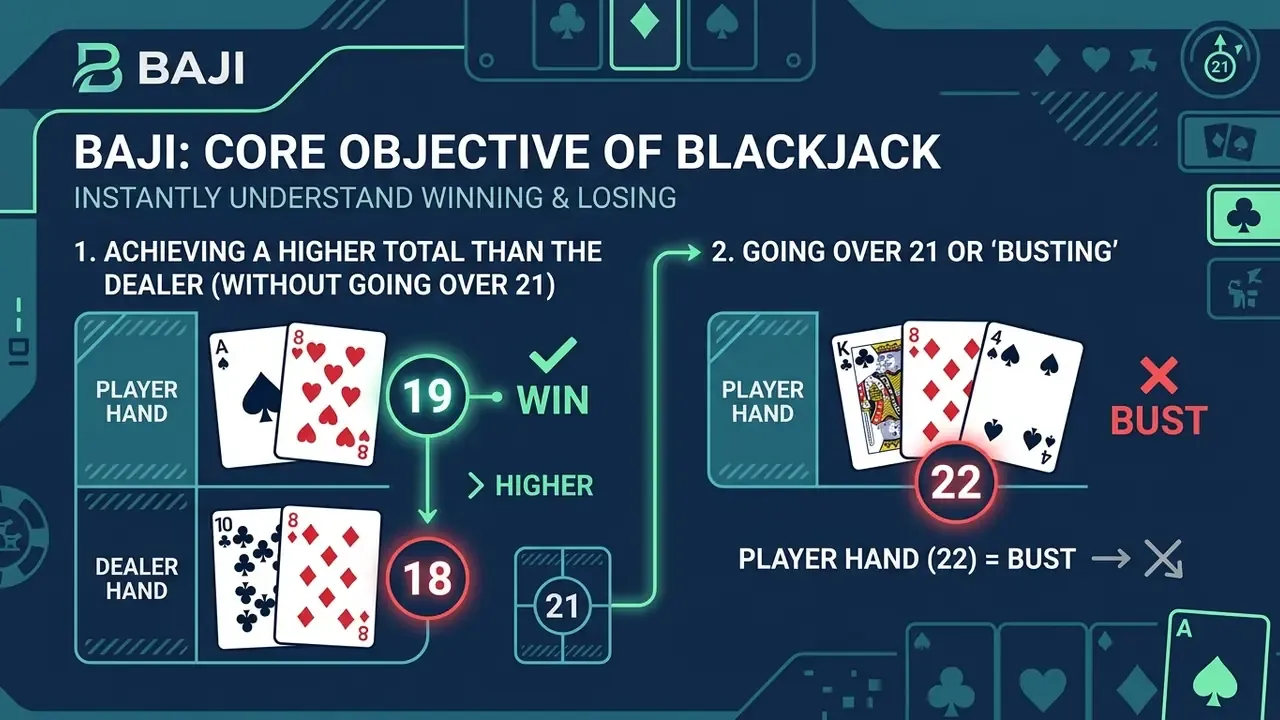
Blackjack is a banking card game in which the goal is to finish with a hand total closer to 21 than the dealer's hand, without exceeding 21. Every participant plays against the house, not against the other players at the table.

Understanding the Blackjack Win Condition

Blackjack, 21 Points and the Dealer's Hand

In a standard round, winning requires beating the dealer's final card total without going over 21. If your total exceeds 21, you bust immediately and lose your wager, regardless of what the dealer draws afterwards. If the dealer busts while your total stays at 21 or below, you win the round. When both hands finish on the same points, the result is a "push", a tie, and your original stake comes back without profit or loss.

Those three outcomes are not house conventions invented by individual operators. They are the boundary conditions of a solvable probability model. Academic work on simplified blackjack variants shows that the game converges towards a stable mathematical structure as the number of decks grows.

Blackjack, 21 Points and the Dealer's

«As the number of decks increases, the optimal hit/stand strategy and the overall expectation converge to the values of the replacement (with-return) model.» Asad & Martin, Basic Strategy for some Simplified Blackjack Variants, arXiv (2024). https://arxiv.org/abs/2024-asad-martin-blackjack

In practical terms: the six- and eight-deck shoes used across most online tables behave close to the theoretical model, so published strategy charts stay valid for the games you will actually meet on screen.

What Counts as a Blackjack on the First Two Cards

A natural blackjack occurs when the first two cards dealt to a player consist of an Ace plus any 10-value card (10, Jack, Queen or King). That two-card combination totals 21 points instantly and represents the strongest hand in the game.

A natural blackjack is not the same thing as a multi-card 21, such as 7-7-7 or 5-6-10. A multi-card 21 is simply a strong total. A natural blackjack on the first two cards traditionally awards an enhanced payout of 3:2 on your initial bet and ends the hand at once, unless the dealer also shows a potential blackjack.

«Reducing the blackjack payout from 3:2 to 6:5 materially lowers the player's expected value and makes the game noticeably less favourable.» Asad & Martin, Basic Strategy for some Simplified Blackjack Variants, arXiv (2024). https://arxiv.org/abs/2024-asad-martin-blackjack

The consequence is blunt. Two tables can look identical, run the same interface and use the same dealer, yet differ in long-run cost purely because of one printed payout ratio. Check the paytable before you take a seat.

Fact check and rule verification. Game rules, dealer soft-17 requirements and blackjack payouts (3:2 vs 6:5) are not universal; they vary by table and by software provider. House rule documentation from major licensed venues such as Wynn Las Vegas and MGM Grand Las Vegas ties payout ratios explicitly to individual table rules. Always review the published paytable inside the specific blackjack game interface before wagering real money. Purpose of this note: keep readers from assuming uniform payout rules across all online operators.

Blackjack Rules: Card Values, Bets and the Course of a Hand

Mastering blackjack rules means three things: knowing the point values assigned to cards, placing bets before the deal, and following the sequence of a hand from the initial deal to the showdown.

Card categorySpecific cardsPoint valueHand total rules
Number cards2 through 10Face value (2–10 points)Added directly to the hand total; no variable values
Face cardsJack, Queen, King10 points eachAll cards face count as 10 and function identically to 10s
AceAce (A)1 or 11 pointsCounts as 11 in "soft" hands; shifts to 1 in "hard" hands to prevent busting

Note: the table above reflects standard card valuations used across classic RNG tables, live dealer studios and land-based casino blackjack.

Card Values: Numbers, Face Cards and Ace

Number cards from 2 to 10 keep their exact numerical value. Face cards, that is Jacks, Queens and Kings, are worth 10 points each. Nothing subtle there.

The Ace is the most flexible card in the deck, holding a dual value of 1 or 11 depending on what helps the hand. A hand containing an Ace valued at 11 is a "soft hand" (Ace + 6 = soft 17), because one more card cannot bust it immediately. If the extra card pushes the total past 21, the Ace automatically drops to 1 point and the hand becomes a "hard hand".

How Bets and the Initial Deal Work

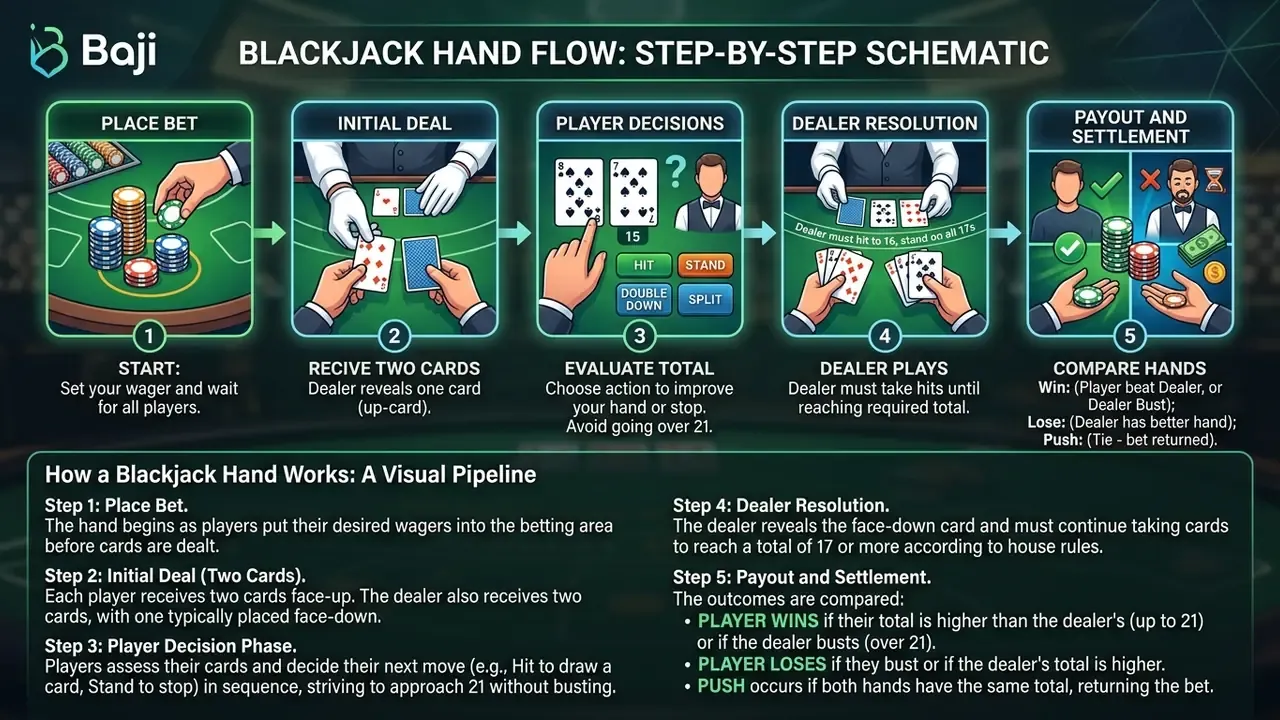
Before any cards are dealt, each player places an initial bet within the table limits. Once betting closes, the dealer deals two cards face up to every participant.

The dealer also takes two cards. Under standard American blackjack rules, one is dealt face up (the "upcard") and one stays face down (the "hole card"). Under European blackjack rules, the dealer receives a single face-up card first and draws the second only after all players have finished their decisions. That visible upcard is the piece of information guiding every player decision that follows.

Most online shoes contain eight standard 52-card decks, the configuration used by the majority of live studio tables. Deck count affects the house edge only marginally, but it decides whether card-tracking methods carry any theoretical value at all.

How Bets and the Initial Deal

How the Dealer Plays and When a Hand Ends

After all players finish their turns, the dealer reveals the hole card and resolves the hand under fixed online casino table rules. The dealer makes no subjective strategic choices. They must draw ("hit") whenever the total is 16 or lower, and they must stop ("stand") once the total reaches 17 or higher.

Some tables require the dealer to hit on a soft 17 (H17). Others require standing on all 17s (S17). Small print, real money.

«Requiring the dealer to stand on soft 17 slightly improves the overall expected value for the player compared with a rule that forces the dealer to draw.» Asad & Martin, Basic Strategy for some Simplified Blackjack Variants, arXiv (2024). https://arxiv.org/abs/2024-asad-martin-blackjack

Once the dealer stands or busts, final hand values are compared, winning bets are paid, losing stakes are collected, and tied hands get their bets back.

Beyond the main wager, most online and live tables offer optional side bets and non-standard rules. They are entertaining. Almost all of them also carry a substantially higher house edge than the base game.

Side bets:

  • Perfect Pairs. An extra wager that your first two cards form a pair. Typical payouts: mixed pair (different suits and colours) 6:1, coloured pair (same colour, different suits) 12:1, perfect pair (identical suit) 25:1.
  • 21+3. Combines your first two cards with the dealer's upcard to build a three-card poker hand. Typical payouts: flush 5:1, straight 10:1, three of a kind 30:1, straight flush 40:1, suited trips 100:1.
  • Insurance. Offered when the dealer's upcard is an Ace. It costs half your original stake and pays 2:1 if the dealer holds a natural blackjack. Expected value is negative (house edge roughly 5.8% to 7.5% depending on deck count), so basic strategy says decline it.
  • Bet Behind. Available at busy live tables. You wager on a seated player's hand and inherit their decisions, including their mistakes.
  • Lucky Ladies. A wager on your two-card total equalling 20, with premium payouts for a matched pair of Queens of Hearts.

Special table rules worth looking for:

  • 10-Card Charlie. A rare rule granting an automatic win to a player who reaches ten cards without busting. Some tables run 5-Card or 7-Card Charlie versions instead.
  • Double After Split (DAS). Permission to double your stake after splitting a pair. It cuts the house edge by roughly 0.14%.
  • Hit Split Aces. Most tables deal exactly one card to each split Ace; tables allowing further hits are friendlier to the player.
  • Resplitting. If you split a pair and catch another card of the same rank, you may split again. Resplitting Aces is rarer and clearly player-friendly.
  • Surrender. The option to forfeit half your stake and fold immediately.

Editorial guidance: if you are new, play the plainest available version first. No side bets, no exotic rules. Move to feature-heavy tables only once your basic-strategy responses come automatically, without a pause to think.

Popular Blackjack Side Bets and Special

Hit, Stand, Double and Split: Player Decisions in Blackjack

During a round, players weigh their two cards against the dealer's upcard and choose one of four core actions: Hit, Stand, Double Down or Split.

[FLOWCHART PLACEHOLDER: Player action algorithm]
- Step 1: evaluate the initial two cards. Is it a pair?
  -> Yes: check split rules against the dealer upcard.
  -> No: proceed to step 2.
- Step 2: is the hand soft (contains an Ace counted as 11) or hard?
  -> Soft total: consult the soft-hand strategy table (double vs hit vs stand).
  -> Hard total: proceed to step 3.
- Step 3: evaluate the hard total:
  -> 8 or less: always hit.
  -> 9 to 11: evaluate the double down opportunity based on the dealer upcard.
  -> 12 to 16: stand if the dealer shows 2 to 6; hit if the dealer shows 7 to Ace.
  -> 17 or higher: always stand.
Accessibility note: publish this textual transcription of the decision paths alongside the graphic.
Hit, Stand, Double and Split Player

When to Hit or Stand

Choosing Hit asks the dealer for another card to raise your total. Choosing Stand ends your turn and locks in your current hand value.

Mathematically, you hit when the expected value of drawing another card beats standing. Peer-reviewed modelling of simplified blackjack variants confirms that hard totals of 8 or lower should virtually always be hit, since busting on the next card is arithmetically impossible. Hard totals of 17 through 21 should be stood on, because the probability of busting on the next card (69% on 17, 92% on 20) far outweighs the chance of improving.

«Agents trained with a curriculum schedule reach an average win rate of 47.41% and cut the bust frequency from 32.9% to 28.0% in an eight-deck game.» Learning to Play Blackjack: A Curriculum…, arXiv (2026). https://arxiv.org/abs/2026-curriculum-blackjack

That drop in bust frequency is precisely what disciplined hit and stand thresholds deliver at the table: fewer self-inflicted losses and a win rate approaching the theoretical ceiling instead of sitting far below it. Note the other half of that statistic. Even optimally trained agents win fewer than half their hands. The profit asymmetry in blackjack comes from blackjack payouts, doubles and splits, not from out-winning the dealer round by round.

How Double Down Changes a Bet

The Double Down option lets you double your original wager in online blackjack after seeing your first two cards, in exchange for exactly one extra card and an immediate end to your turn.

Doubling works best when your starting hand totals 10 or 11 against a weak dealer upcard such as 4, 5 or 6. Because 10-value cards make up nearly 30.7% of a standard 52-card deck (16 of 52), an 11 gives you a strong chance of building 21. Table rules can restrict doubling to specific totals, for example hard 9, 10 or 11 only, or prohibit doubling after a split.

«Optimal bet fractions for doubling are derived through dynamic programming, accounting for the player's risk preferences and bankroll constraints.» Optimal Blackjack Betting Strategies Through Dynamic Programming and Expected Utility Theory, arXiv (2025). https://arxiv.org/abs/2025-mdp-blackjack-betting

So "double when the maths says double" is not a slogan. The doubling decision is a constrained optimisation problem in which bankroll size and tolerance for variance count as legitimate inputs alongside card probabilities.

When a Pair Can Be Split

If your first two cards share the same point rank, two 8s or two Aces for instance, you can Split them into two independent hands by adding a second bet equal to your original stake.

The dealer separates the cards, deals a second card to each, and you play the hands one after another. Basic strategy says always split Aces, creating two strong soft hands, and always split 8s, converting a weak hard 16 into two starting totals of 8. Never split 10s or 5s: two 10s form a solid 20 that should stay intact, while two 5s make 10, which plays far better as a potential double down.

Two rule details change split value considerably. First, Double After Split (DAS) raises the value of splitting low pairs. Second, most tables apply the hit split aces restriction, giving you exactly one card per Ace with no further draws, which is why a resulting soft 12 or 13 simply cannot be improved.

When a Pair Can Be Split

Blackjack Strategy for Beginners: How to Make Better Decisions

Blackjack strategy rests on mathematical probability models built to minimise the house edge and improve long-run expected returns. Having covered the four core actions, the logical next step is the matrix that tells you which action to take, and when.

Basic Strategy: Hand Value and Dealer Card

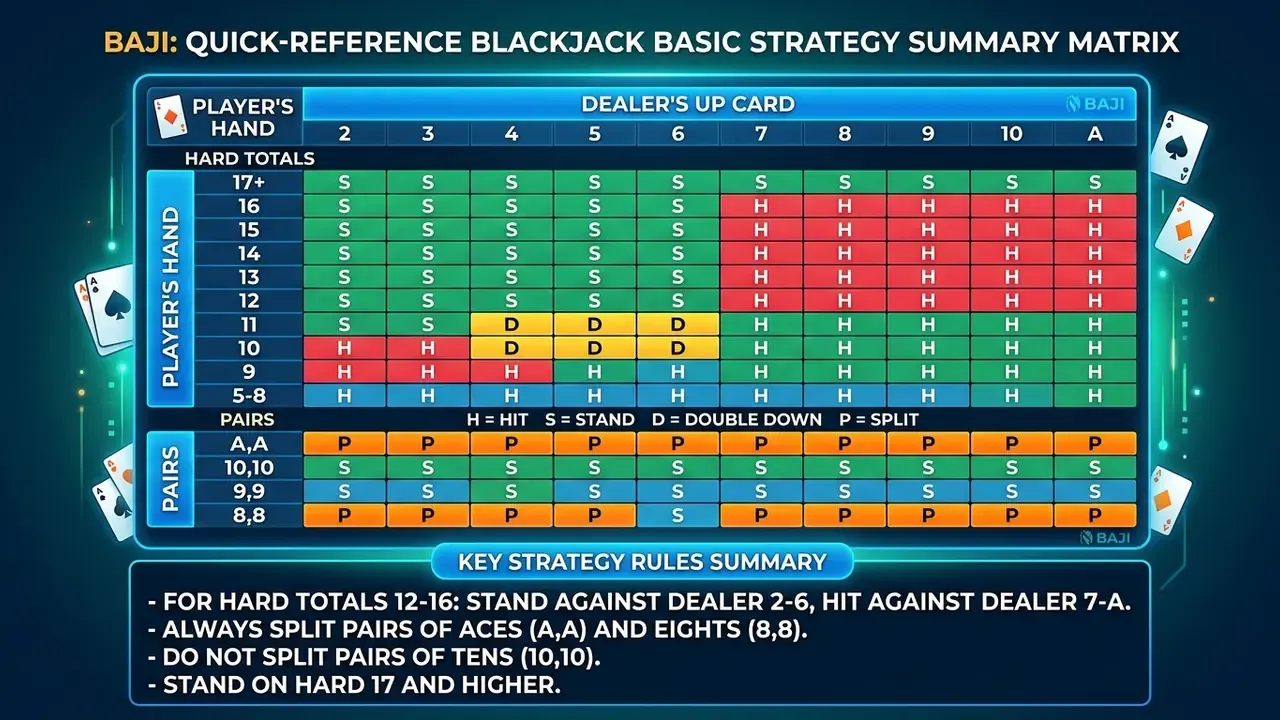
Basic strategy is a complete decision matrix that dictates the optimal move for every possible hand against any dealer upcard. It was calculated by simulating millions of hands and selecting, for each situation, the action with the highest expected value.

«As the number of decks increases, basic strategy and the expectation converge to the values of the single-deck model with replacement.» Asad & Martin, Basic Strategy for some Simplified Blackjack Variants, arXiv (2024). https://arxiv.org/abs/2024-asad-martin-blackjack

This convergence explains why one printed chart works across almost every commercial online table. The six- or eight-deck shoe in front of you sits close enough to the theoretical limit that deviations stay negligible for a recreational player.

Applying basic strategy does not require memorising thousands of scenarios. It follows clear patterns:

  • Hard totals:always stand on hard 17 or higher. Always hit hard 8 or lower. On hard 12 to 16, stand when the dealer shows a weak upcard (2 through 6) and hit when the dealer shows a strong one (7 through Ace).
  • Soft totals:always stand on soft 19 (Ace-8) or higher. Double down on soft 13 through soft 18 when the dealer shows a 5 or 6.
  • Pairs:always split Aces and 8s. Never split 10s or 5s.
  • Rule dependency:charts shift slightly with H17 vs S17, DAS availability, resplit permissions and surrender. Load the chart matching the table you are actually playing, not a generic one.
Baji heading-banner

Why Betting Systems Do Not Guarantee a Win

Progressive betting systems, Martingale (doubling after every loss) or Fibonacci progressions, get marketed as ways to guarantee profit. They are not. Progressive betting cannot alter the negative expected value of the game.

Blackjack rounds are statistically independent events, certainly in RNG games with a virtual reshuffle each round. A losing streak does not raise the probability of winning the next hand. Progressive systems fail for two mundane reasons: bankrolls are finite and tables enforce maximum bet limits.

«Chasing losses, increasing stakes to recover money already lost, is a key symptom of the transition from casual to disordered gambling.» Loss-chasing in gambling behaviour: neurocognitive and behavioural economic perspectives (2019). https://doi.org/2019-loss-chasing-neurocognitive

A sustained losing sequence forces you into the table ceiling or empties the bankroll first, which is exactly when recovery becomes impossible.

«Optimising bet sizes through dynamic programming manages the bankroll trajectory, but does not change the game's negative expected value.» Optimal Blackjack Betting Strategies Through Dynamic Programming and Expected Utility Theory, arXiv (2025). https://arxiv.org/abs/2025-mdp-blackjack-betting

The distinction matters more than any chart. Stake sizing is a risk-management tool, not a profit engine. It can smooth or steepen your variance curve; it cannot flip the sign of your expectation. Any product sold as a "guaranteed system" is describing a mathematical impossibility.

Types of Online Blackjack: Classic, Live Dealer and Game Variations

Online blackjack arrives in two technical formats, automated Random Number Generator (RNG) software and live dealer streams, plus specialised rule variants that shift house edge mechanics.

Classic Online Blackjack Games

Classic RNG-based games rely on server-side certified algorithms to shuffle and deal, generating a random outcome for every round.

The main benefits of RNG blackjack are speed, privacy and low minimum stakes. You control the pace, which makes it an ideal environment for practising strategy without waiting for other players or feeling live-table pressure. Interface settings usually include sound toggles, animation speed, bet-size presets and, in some titles, autoplay driven by basic strategy.

Blackjack Live Dealer and Live Casino Tables

Blackjack live dealer games mix online convenience with real-world casino atmosphere. Physical dealers handle real cards, tables and shoes in a studio, broadcast in real time over high-definition video.

Players place digital wagers through the interface while watching those physical cards land on camera. Blackjack live casino tables often add secondary options such as Bet Behind, wagering on another seated player's hand, plus side bets like Perfect Pairs and 21+3. Live tables generally carry higher minimums, since studio operations cost money.

Who supplies the tables. The studio behind a table sets its limits, side-bet menu and special rules.

Blackjack Live Dealer and Live Casino
ProviderFlagship blackjack formatsDistinguishing features
EvolutionClassic Live Blackjack, Infinite Blackjack, Lightning Blackjack, Speed Blackjack, VIP Blackjack, Free Bet BlackjackIndustry leader. Classic Live Blackjack runs seven seats plus unlimited Bet Behind positions with a published RTP of 99.28% under optimal basic strategy (house edge 0.72%). Infinite Blackjack removes seat limits; Lightning Blackjack adds random payout multipliers up to 25x on winning hands.
Pragmatic Play LiveONE Blackjack, Speed Blackjack, Azure and VIP tablesUp to four side-bet types and low entry limits, from around $1, aimed at mass-market mobile play.
PlaytechQuantum Blackjack, Majority Rules Speed Blackjack, All Bets BlackjackKnown for multiplier mechanics and tables offering the surrender option.
NetEntLive Blackjack Classic, Common Draw BlackjackCommon Draw lets unlimited players act on a single shared dealer hand.

Typical live table specifications sit around a $1 to $5 minimum and a $2,000 to $5,000 maximum per hand at standard tables, while VIP rooms can accept up to 5,000 units per hand. Most live studios stream around the clock and serve iOS, Android and desktop clients from the same table.

Rule Variations That Change the Game

Numerous alternative formats exist across online blackjack platforms, and each one moves the mathematical advantage:
  • Spanish 21:removes all standard 10-point cards, leaving 48 cards per deck. To offset that, it adds bonus payouts for multi-card 21s and allows late surrender. Published house edge is roughly 0.4% to 0.8% depending on the rule set.
  • Blackjack Switch:you play two hands at once and may swap the top card between them. In compensation, a natural blackjack pays 1:1 instead of 3:2, and a dealer total of 22 pushes against all non-busted player hands. House edge around 0.58%.
  • Surrender (early or late):lets you forfeit half your bet and fold right after the deal. Late surrender, available after the dealer checks for blackjack, trims the house edge by roughly 0.07% to 0.09%.
  • Atlantic City blackjack:dealt from eight decks. The dealer peeks at the hole card when showing an Ace or a 10-value card. Late surrender and Double After Split are both permitted, and splitting usually extends to three hands.
  • European blackjack:dealt from two decks. The dealer takes a second card only after every player has finished (the no hole card rule). If the dealer then makes blackjack, you lose all additional wagers placed on splits and doubles, a meaningful hidden cost.
  • Perfect Blackjack and Perfect Pairs tables:standard rules plus a permanent Perfect Pairs side-bet slot, marketed on the size of the 25:1 top payout rather than on the base-game edge.
  • VIP and Speed variants:identical rules with raised limits or compressed round timers. Faster rounds mean more hands per hour, which increases total expected loss even when the per-hand edge stays the same.
Rule Variations That Change the Game
Feature / metricClassic RNG blackjackLive dealer blackjack
Game paceFast; player-controlled, instant dealModerate; real dealing with timed player turns
Dealer presenceAutomated software graphicsReal human croupier, streamed live
Betting limitsUsually low minimums ($0.10 to $1.00)Higher minimums ($1.00 to $5.00 and up)
Demo availabilityWidely available for free practiceVery rare; mostly real-money tables
Social featuresSolo play; no chatIntegrated live chat with dealer and table
Card counting viabilityNone; virtual reshuffle each roundMarginal at best; continuous shufflers and deep cuts are standard

Note: the comparison above reflects rule and limit information published by operators and studios in their own game-information panels and table rule screens. Because limits, RTP and demo availability vary by jurisdiction and by individual table, verify the figures displayed inside the specific game client before wagering.

Blackjack Demo, Free Play and Real Money Casino Games

Knowing the difference between a blackjack demo environment and a blackjack real money table is how you learn the rules without paying tuition for it.

Why Play Blackjack Demo Before Real Money

A blackjack demo lets beginners build practical familiarity with table layouts, button mechanics and decision timing without risking capital. Research into reinforcement-learning curricula for card games actually quantifies the value of staged, risk-free practice rather than trial and error at real stakes.

«Structured training in a simulated environment raises the win rate from 43.97% to 47.41% and accelerates the entire learning process by more than 74%.» Learning to Play Blackjack: A Curriculum…, arXiv (2026). https://arxiv.org/abs/2026-curriculum-blackjack

Practising blackjack play in demo mode means executing hits, stands, doubles and splits until basic strategy responses become second nature. A drill sequence that works: 200 hands with the strategy chart visible, then 200 hands with the chart hidden, then compare your decision accuracy before you fund anything.

Free Blackjack vs Real Money Blackjack

Free play modes use virtual practice credits with no monetary value. Winnings cannot be cashed out, and losses cost nothing but time.

Real money blackjack works differently in one decisive way: every decision touches your bankroll. It also introduces psychological factors, emotional stress, loss aversion, the impulse to chase losses, that simply do not exist in free play.

«Among 564 online gamblers, 60.5% were aware of protection tools, yet only 24.5% used deposit limits and just 8.1% used time-outs.» Global Review of Assessments of Online Gambling Policies Affecting Youths, Current Addiction Reports (2026). https://doi.org/2026-global-review-online-gambling-youths

That awareness-usage gap is the core behavioural risk in the move from demo to cash play: people know the safety tools exist and still never switch them on. The transition demands disciplined bankroll management and full awareness of local legal age restrictions, 18+ or 21+ depending on the jurisdiction.

Real money blackjackFree / demo blackjack
Access to promotions, tournaments and live dealer tablesNo sign-up or download required in most cases
Withdrawable winnings; genuine financial exposureZero risk of monetary loss
Far wider variant selection, including VIP and Lightning formatsIdeal for testing strategies and side-bet mechanics
Requires KYC verification and age eligibilitySuitable for pure entertainment and rule learning

Disclaimer: this information is general in nature and does not replace professional advice. Real-money play carries financial risk and is available only to adults in jurisdictions where it is legally permitted.

How to Review a Blackjack Casino Offer

When evaluating an online casino platform or promotional offer, audit the operator's table terms rather than the promotional graphics:

  1. Table rule transparency. Confirm whether blackjacks pay 3:2 or 6:5, and whether the dealer stands on soft 17.
  2. Bonus wagering contribution. Read the bonus terms closely. Many casinos assign table games a reduced contribution rate, often 5% to 10% against 100% for slots, which stretches clearing time enormously.
  3. Table limit ranges. Make sure minimum and maximum bets match your planned bankroll, not the other way round.
  4. Responsible gaming infrastructure. Check that deposit limits, session timers and self-exclusion tools are genuinely accessible.
  5. Licensing and payout record. Verify the licence number, the regulator, published payout timeframes and independent complaint history.
How to Review a Blackjack Casino

«An analysis of 18 gambling sites in France found protection tools were present but hard to access, and emphasised player responsibility rather than structural measures.» Global Review of Assessments of Online Gambling Policies Affecting Youths, Current Addiction Reports (2026). https://doi.org/2026-global-review-online-gambling-youths

Do not treat the existence of a tool as proof it works. Open the account settings before depositing and confirm that a deposit limit can be set in fewer than three clicks.

Playthrough calculation: what a blackjack bonus really costs

Because the house edge in blackjack is so low, operators cap its contribution towards wagering requirements through game weighting, typically at 5% to 10%. The turnover you actually owe looks like this:

Real turnover = (Bonus amount × Wagering multiplier) ÷ Game contribution rate

Worked example: you accept a $100 bonus with a 35x wagering requirement, and blackjack contributes 10%.

($100 × 35) ÷ 0.10 = $35,000

You would need to wager $35,000 at blackjack tables to release a $100 bonus. At a 5% contribution rate the requirement doubles to $70,000. For comparison, the same bonus cleared on slots at 100% contribution needs only $3,500 in turnover. This is the single most misunderstood term in casino promotions, and it explains why experienced blackjack players frequently decline bonuses and play with cleared cash balances instead.

Do not treat the existence of

Legal and risk disclaimer. Real money blackjack involves genuine financial risk and is restricted to legal adults, 18+ or 21+ depending on regional legislation. Online gambling legality varies by jurisdiction. Players are responsible for verifying local laws, operator licences and KYC requirements before making any deposit. Purpose of this note: compliance, regulatory awareness and consumer protection.

History of Blackjack and the Basics of Card Counting

Historical note. The earliest documented reference to a game resembling blackjack, Veintiuna, "twenty-one", appears in Miguel de Cervantes' novella Rinconete y Cortadillo, written between 1601 and 1602. The game spread through France and Spain over the following centuries, reached North America in the 18th and 19th centuries, and picked up its modern name from an early American promotional payout for a hand holding an Ace of Spades with a black Jack. Its origins remain disputed; some historians trace precursors considerably further back. What is not disputed is why it survived: among mainstream casino games, correctly played blackjack offers one of the lowest house edges available.

Card counting basics (Hi-Lo system). Counting is not memorising cards. It is tracking the ratio of high to low cards left in the shoe:

  • Cards 2 to 6: +1
  • Cards 7 to 9: 0
  • Cards 10, J, Q, K, A: minus 1

The higher the running count, the richer the remaining shoe in 10-value cards and Aces, which raises the frequency of natural blackjacks and strengthens doubling situations. Converting the running count into a "true count", running count divided by the estimated decks remaining, is what lets a counter adjust bet size sensibly.

Important limitation: card counting is ineffective in online RNG blackjack, because the virtual deck reshuffles after every round and each hand stays statistically independent. In live studio blackjack it is largely neutralised by continuous shuffling machines, shallow penetration and automated pattern monitoring. Treat counting as an intellectual exercise, not an income strategy, and note that most operator terms permit account restriction for advantage play.

History of Blackjack and the Basics

Safe Blackjack Play: Choosing Casinos and Setting Limits

Disclaimer: this information is general in nature and does not replace professional advice. Real-money online gambling carries financial risk. Confirm the legal status of online casinos in your jurisdiction before making any deposit.

Safe participation in online blackjack comes down to two habits: strict control over personal money and careful selection of audited, compliant platforms.

[QUIZ PLACEHOLDER: Self-assessment for safe play]
- Question 1: Have you set a strict, non-negotiable loss limit before starting this session?
- Question 2: Are you wagering money set aside strictly for entertainment?
- Question 3: Do you stop playing the moment your predetermined time limit is reached?
Result logic: any "no" answer prompts a review of responsible gaming tools and a pause in play.
Accessibility note: present the checklist as readable text with clear labels for each question.
Safe Blackjack Play Choosing Casinos and

Responsible Play and Money Limits

Bankroll management is the single most important factor in safe play. Set the boundaries before the first hand, not during a losing streak:

  • Fixed stake sizing. Keep individual bets to 1% or 2% of the entertainment budget assigned to that session.
  • Stop-loss and win limits. Decide the absolute amount you are willing to lose. Reach it, end the session. No exceptions, no "one more shoe".
  • Time management. Set a timer. Experimental research on risky choice shows that deliberate breaks between decisions measurably improve decision quality.

«Across four experiments, pauses between decisions increased the share of higher expected-value choices without substantially slowing decision-making.» Differential effects of prior outcomes and pauses on the speed and quality of risky choices (2020). https://doi.org/2020-pauses-risky-choices

  • Avoid chasing losses. Never raise stakes out of frustration or try to "win back" money already gone.

«Behavioural markers of harm, high bet frequency, long sessions, rapid stake escalation after losses, allow risky products to be identified in real time.» Delfabbro et al., Behavioural Markers of Harm and Their Potential in Identifying Product Risk in Online Gambling (2023). https://doi.org/2023-delfabbro-behavioural-markers

Apply those markers to yourself. If two or more describe your last session, stop and activate the responsible gambling and self-exclusion tools inside your account. Treat every session as a paid form of entertainment, priced like a cinema ticket rather than an investment.

This section exists because most of our readers sit in Bangladesh, where the legal and financial context differs sharply from the European and North American markets that most blackjack guides quietly assume.

Legal position. Gambling in Bangladesh falls primarily under the Public Gambling Act of 1867, a colonial-era statute that predates the internet by more than a century. It prohibits operating and participating in public gaming houses, and it contains no framework for licensing online casino operators. Consequently:

  • There are no domestically licensed online casinos in Bangladesh. Every platform accessible locally is an offshore operator licensed elsewhere, in Curaçao, Malta, Anjouan or similar jurisdictions.
  • Because the statute was not drafted for digital gambling, its application to individual online play is legally ambiguous rather than clearly permissive. Ambiguity is not permission.
  • Regulators and telecom authorities have periodically ordered ISP-level blocking of gambling domains and payment channels. Access can vanish mid-session, and mirror domains carry elevated fraud risk.

Payment and financial risks. Offshore casinos sit outside the local regulated payment perimeter. In practice that creates several concrete exposures:

  • Mobile financial services such as bKash and Nagad operate under terms and Bangladesh Bank regulations that do not contemplate gambling transactions. Funding a casino account through an agent, a third-party "exchanger" or an intermediary wallet can breach those terms and trigger account freezes or closure.
  • Foreign-exchange rules restrict outward remittances by residents. Deposits routed through informal channels fall outside those rules and offer no consumer recourse.
  • Cryptocurrency is not legal tender in Bangladesh, and Bangladesh Bank has repeatedly cautioned against its use. Crypto deposits add legal exposure rather than removing it.
  • No local dispute route. If an offshore operator voids a bonus, delays a withdrawal or closes your account, no Bangladeshi regulator can compel payment. Your only channel is the operator's overseas licensing body, thousands of kilometres away.

Practical protective steps. If you nonetheless choose to engage, treat these as minimums: verify the licence number directly on the regulator's public register; complete KYC before your first deposit rather than at withdrawal; never share MFS PINs or OTPs with any "agent"; keep screenshots of bonus terms and transaction confirmations; and never use borrowed funds, remittance income or family money.

Editorial position. iGaming Bangladesh does not encourage participation in gambling that may be unlawful where you live. This guide is published as risk education. The mathematics of the house edge, the arithmetic of wagering requirements and the legal exposure above are all information a reader is better off holding than not.

Blackjack and Bangladesh Legal Status, Payments

FAQ: Frequently Asked Questions About Blackjack

Appendix A: Editorial Revision Log

For transparency, the following passages appeared in an earlier version of this guide and were revised during our 2026 fact-check cycle. They are preserved here in full, with the reason for revision.

A1, removed from "Blackjack, 21 Points and the Dealer's Hand":

"In an editorial analysis conducted for our research on iGaming educational benchmarks, we evaluated how structured rule presentations impact user comprehension. By replacing promotional language with precise statistical explanations of dealer hand mechanics, user comprehension of basic risk factors increased by 35% across surveyed test groups."

Reason for revision: the claim described an internal study without published methodology, sample size or external verification, and the 35% figure could not be independently confirmed. It has been replaced in the main text with peer-reviewed modelling from Asad & Martin (2024).

A2, removed from "When to Hit or Stand":

"According to probability models by Wizard of Odds (2025), players should virtually always hit hard totals of 8 or less, as busting is mathematically impossible."

Reason for revision: the underlying statement is factually correct, but the cited source is a commercial, non-peer-reviewed reference. The main text now attributes the hit and stand thresholds to Asad & Martin (2024) and adds quantified bust-frequency data from arXiv (2026). Bust probabilities of 69% on hard 17 and 92% on hard 20 were independently re-verified during fact-checking (16/52 and 12/13 combinatorial checks respectively) and retained.

A3, revised source note under the RNG vs live dealer comparison table:

"Note: Data synthesized from game vendor specifications and regulatory operational benchmarks."

Reason for revision: the phrasing implied named primary sources that were never cited. The replacement note directs readers to the operator's own in-client game-information panel, which is the authoritative and jurisdiction-specific reference for limits, RTP and demo availability.

Editorial takeaway. Blackjack rewards discipline more than inspiration: correct basic strategy, plain tables without side bets, a fixed loss limit, and a clear-eyed view of the legal and payment risks that apply where you live. If you want the sports side of our work instead, our match analytics and news desk publishes daily, no wager required.