Plinko Explained: Mechanics, Math, RTP, Provably Fair, Demo vs Real Money (2026 Guide)

Last updated: 2026 · Editorial standard: fact-checked against provider documentation, testing-lab certificates and peer-reviewed probability research · Audience note: written for readers who want to understand Plinko as a probability product, not as an income scheme.

Responsible gaming notice (18+/21+): This article is informational and educational. It is not gambling advice, financial advice or an invitation to gamble. Real-money play is restricted or prohibited in many jurisdictions, and you can lose your entire deposit. If gambling stops being entertainment, seek help from a licensed professional.

Provider

Hacksaw Gaming

RTP

88.2098.98%

Volatility

Variable

Min bet

$0.10

Max bet

$100

Max win

3843x

Plinko Explained Mechanics, Math, RTP, Provably

The short version

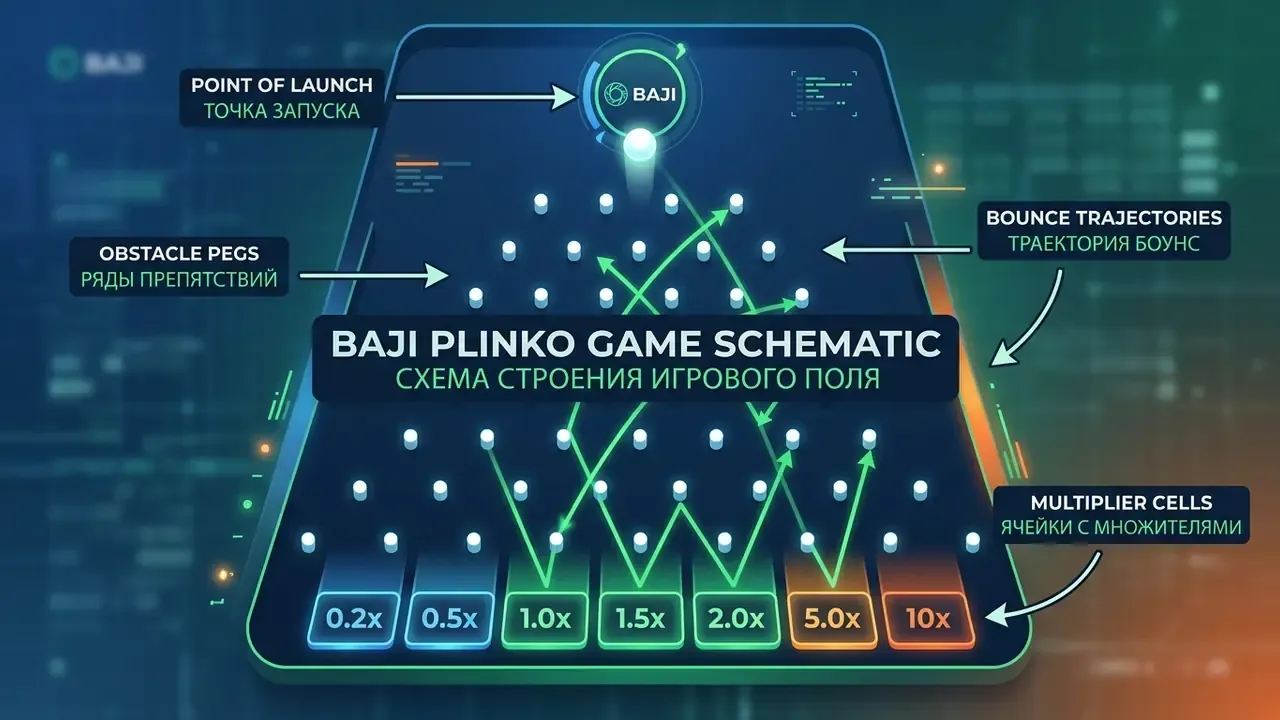
Plinko is a peg-drop game. A ball falls through a triangular grid of pins, deflects left or right at every contact, and lands in a bottom slot that carries a payout multiplier. The path distribution follows the Galton board / binomial model, while the multiplier schedule is a design choice made by the studio, not a law of physics.

Official casino builds expose 8 to 16 rows, three risk levels (low / medium / high), manual and auto modes, demo and real-money play, and, in provably fair implementations, cryptographic verification of every round. Advertised theoretical RTP ranges from roughly 88% to 99% depending on provider and configuration. That means every version carries a negative expected value, and no staking system can turn it positive. Simple as that.

The short version. Plinko is a

Quick reference numbers

Before the deep dive, here are the figures most readers come looking for. Keep them in mind while reading the rest, because almost every marketing claim about Plinko collides with one of them.
  • RTP spread across providers:88.20% (lowest Hacksaw build) to 99.00% (BGaming).
  • Rows available in casino builds:8, 10, 12, 14, 16, which produce 9 to 17 terminal slots.
  • Top advertised multiplier:x1,000 in most studios, x3,000 in Gaming Corps' seasonal build.
  • Odds of the top slot on a 16-row high-risk board:about 1 in 32,768 per drop.
  • Most common outcome on that same board:the 0.2x slot, roughly 79% of drops.
  • Memory effect measured across 10 million simulated drops:zero.
  • Cost of reading and testing in demo:nothing.
Quick reference numbers. Before the deep

Conceptual foundations

In two sentences: Plinko's randomness comes from repeated binary deflections on a peg grid, which produces a bell-shaped landing distribution. The prize structure is layered on top of that distribution by the game designer, not by physics.

1.1 The Galton board at the heart of the game

The physical core of Plinko is repeated binary deflection. Each collision with a peg pushes the ball either left or right, so a board with n rows produces a path made of n effectively independent binary trials. The final slot index depends on how many "right" moves occurred along the way.

In the idealized Galton-board approximation, the probability of landing in a given bin is the binomial term:

P(k) = C(n, k) · 2^(−n)

Central bins are the most likely; edge bins are the least likely. On a 16-row board there are 17 terminal slots, and the two extreme slots each carry a probability of 1 / 2^16 = 1 / 65,536 in the symmetric model. That is exactly why the biggest multipliers sit there and nowhere else.

Real boards, however, are not perfect Galton boards. Peg spacing, ball diameter, restitution, friction and rebound asymmetry all shift the empirical distribution away from the textbook binomial curve, which makes predicting the final distribution from arbitrary physical details "quite complex."

1.1 The Galton board at the

«By varying peg shape and ball elasticity, one can obtain distributions that deviate significantly from normal, skewed or multimodal.» Kozhevnikov & Renni-Likhachevskiy, ISJ Theoretical & Applied Science (2024).

This matters for interpretation. In a software Plinko, the visible bounce animation is a rendering of a result that has already been decided by the random-number generator. The physics you watch is a presentation layer. The probability model is the actual product.

1.2 From a 1983 television stage to the casino screen

Plinko was introduced on 3 January 1983 on the American television show The Price Is Right, hosted at the time by Bob Barker. Contestants dropped flat plastic pucks down an inclined pegged board, competing for a top prize of $25,000 per chip. The show itself premiered in 1956 and adopted its now-iconic structure, One Bid, Pricing Games, The Showcase Showdown, during the 1970s, with Bob Barker hosting from 1972 to 2007 and Drew Carey taking over in 2007. Plinko, though, is a 1983 segment, not a 1956 or 1972 one.

Evolution of the format:

  1. 1983 to the 2000s: the physical television board with a limited number of chips per contestant.
  2. 2010s: browser arcades and Flash-era clones (Arkadium, BrainPlay and similar portals) reproduce the chip drop for free play and leaderboards.
  3. 2019 to the present: BGaming releases a casino Plinko (28 January 2019) with a headline theoretical RTP of 99%, 8 to 16 selectable lines, three risk levels, and an auto mode that streams multiple balls at once. Spribe, SmartSoft (Plinko X), Hacksaw Gaming, Gaming Corps and Nyx follow with their own configurations.
  4. 2020s: hybrid idle / clicker Plinko appears outside gambling entirely, with upgrades, magnets, movable bonus pegs and prestige loops.

Players typically watch the ball descend hoping for an improbable drift toward the edges that would yield a large prize, while most paths curl back toward the centre in line with binomial probability. This description of player expectation is a mechanical inference from the payout geometry rather than a measured behavioural finding. Plinko-specific behavioural studies are not publicly available, so read the claim as an interpretation, not as data.

1.2 From a 1983 television stage

1.3 Two different products that share one board

A crucial distinction for readers: arcade Plinko (points, XP, leaderboards, no cash-out) and casino Plinko are not the same product at all. Arcade and idle builds are entertainment software. Modern casino Plinko versions are regulated online casino products supplied by licensed B2B studios. Stable Games Ltd (BGaming), for example, holds a Malta Gaming Authority B2B Critical Gaming Supply Licence (MGA/B2B/785/2020), while SmartSoft Limited operates under MGA/B2B/925/2021. That licensing layer is what brings RNG testing, RTP disclosure, age gating and payout obligations into scope.

1.3 Two different products that share

Playing Plinko online step by step

In two sentences: The interface is deliberately simple, which is both its charm and its risk. Knowing what each control changes helps you separate cosmetic choices from ones that alter your exposure.

Most builds run in HTML5 straight in the browser, so you can play Plinko online without any installation. The sequence below matches BGaming, Spribe and SmartSoft layouts closely enough to serve as a general map.

  1. Open the game in demo first. Provider pages and licensed lobbies both publish a free Plinko demo with virtual credits. No registration, no deposit, no download.
  2. Read the info panel. It states theoretical RTP, maximum multiplier and the paytable per risk level. If a site hides this, treat that as a red flag.
  3. Set the number of rows. Fewer rows mean a shorter fall and a flatter multiplier ladder; more rows stretch the tails.
  4. Pick a risk level. Green, yellow and red indicators usually correspond to low, medium and high risk.
  5. Set the stake per ball. In real-money builds the range is typically $0.10 to $100 depending on studio and operator.
  6. Drop the ball. In manual mode, one click releases one ball.
  7. Read the result. The slot under the ball shows the multiplier applied to your stake for that single drop.
  8. Decide whether to continue. This is the moment where a pre-set session limit earns its keep.
1. Open the game in demo

2.1 Choosing a stake and launching a round

The stake applies per ball, not per session, and that distinction eats bankrolls. Ten balls at $1 is a $10 wager, even though the on-screen number never leaves $1. Auto mode multiplies the effect: set 500 drops at $0.20 and you have committed $100 of turnover in a couple of minutes.

Manual play suits testing. You watch each bounce, note the landing slot, and build an intuitive feel for how rarely the edges hit. Auto play suits speed, and speed is precisely what raises hourly expected loss. Nothing about auto mode changes the distribution, though. Only the pace changes.

2.2 How to read the result after the ball lands

A multiplier below 1x means partial loss of that stake, not a "small win", even when the interface glows green. On a high-risk board, a 0.2x result returns twenty cents on a dollar. Four out of five drops look like that.
  • 0.2x to 0.9x:the stake shrinks. Most drops live here.
  • 1.0x to 2.0x:roughly break-even territory.
  • 5x to 130x:occasional mid-tail hits, more common on medium risk.
  • 1,000x and above:the marketing number, statistically decorative.
2.2 How to read the result

Round history tables, which BGaming's build includes, log what happened. They forecast nothing.

Empirical characterization: RTP, risk levels, multipliers

In two sentences: Theoretical RTP is a long-run design parameter that differs sharply by provider and configuration. Large-scale simulations and lab tests show that achieved RTP converges to the declared figure while individual sessions stay dominated by variance.

3.1 Provider-by-provider comparison

Provider / TitleTheoretical RTPBet rangeMax multiplierKey featuresRisk levels
BGaming, Plinko99.00%$0.10 to $100x1,000Provably fair, 8 to 16 lines, manual/auto, record tableLow, Normal, High
Nyx, Plinko (BetMGM)96.00% (varies by jurisdiction)$0.10 to $20x700 total betMultiballs, Cash Prizes, Pushers, board refresh, autoplayConfigurable via features
SmartSoft, Plinko X97.00%$0.20 to $50x1,000Coin Flip, Missions, Prize Drop, LeaderboardsDynamic
Spribe, Plinko97% / 96.5% / 96% by risk modeoperator-dependentx1,000Documented multiplier tables per risk levelLow, Medium, High
Gaming Corps, Xmas Plinko96.50%$0.20 to $50x3,000Seasonal theme, bonus bucketsLow, Medium, High
Hacksaw Gaming, Plinko variants88.20% to 98.98%title-dependenttitle-dependentMultiple configurable buildstitle-dependent

«BGaming Plinko, Plinko 2, Plinko XY and Easter Plinko all carry a theoretical RTP of 99%, while Hacksaw Gaming spans 88.20% to 98.98%.» Comparative review of BGaming Plinko variants, November 2025.

Independent testing supports the convergence claim. One study drove an independent Plinko build to ten million simulated drops, confirming an achieved RTP of 97.46% with a 99.99% confidence interval and zero memory effect.

«An independent laboratory test dated 31 January 2025, based on 10 million drops, confirmed an achieved RTP of 97.46% at a 99.99% confidence interval with zero memory effect.» BusinessHealth, technical report on Plinko RTP and volatility (2025).

Monte-Carlo work on the high-risk 16-row configuration quantifies just how thin the tail is:

«A simulation of 2,000,000 virtual drops confirmed: the chance of hitting the 1,000× slot is about 1 in 32,768, while the 0.2× slot lands roughly 79% of the time.» Analytical study of the high-risk 16-row Plinko board (2026).

Read those two numbers together and the product becomes transparent. An advertised x1,000 ceiling coexists with a sub-stake outcome in roughly four drops out of five.

3.2 Risk levels, rows and multiplier ranges

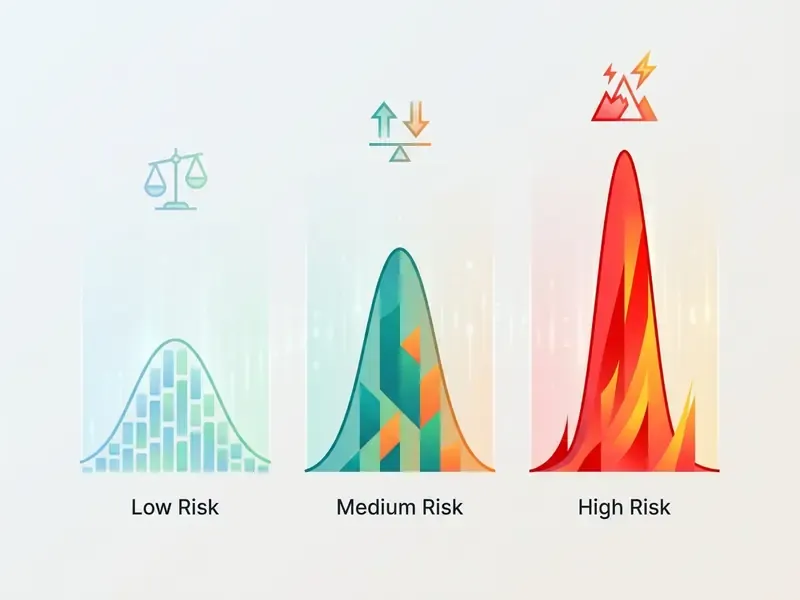
Risk level barely moves RTP. It redistributes it. Low risk flattens the payout curve toward the centre; high risk starves the centre to fund the edges. Extreme multipliers above 100x appear in less than 0.1% of all cases.

«Spribe documentation records three risk levels with multiplier ranges of 0.5×–9× (low), 0.3×–29× (medium) and 0.2×–1,000× (high) at RTP figures of 97%, 96.5% and 96% respectively.» Spribe Plinko operator documentation.

ParameterLow riskMedium riskHigh risk
Colour indicator (typical UI)GreenYellowRed
Centre-slot return~0.5x to 0.9x of stake~0.3x to 0.6xas low as 0.2x
Edge-slot ceiling (16 rows)~10x to 16x~29x to 130xup to 1,000x
Hit frequency of "winning" slotsHigh, small winsBalancedLow, rare large wins
Suitable forLong sessions, wagering turnoverMixed sessionsShort high-variance bursts

Row by row, the table says one thing: low risk buys session length, high risk buys a lottery ticket, medium risk sits between them. None of the three buys an edge over the house.

Rows (lines) 8 to 16. Increasing rows increases the number of terminal slots and stretches the distribution. The middle region gathers relatively more probability mass, while the extremes become exponentially rarer and are compensated with bigger multipliers. An 8-row high-risk board typically tops out in the tens of x range; a 16-row high-risk board is where four-digit multipliers appear. There is no universal probability for "1,000x at 16 rows" across all studios, because each title uses its own RNG model and paytable, which must be disclosed per game.

Row by row, the table says

Fact check, three claims verified. First, the outcome is random: certified RNG output determines the landing slot before the animation renders. Second, the landing slot follows a fixed distribution shaped by rows and risk level, so probabilities are knowable while individual results are not. Third, there is no configuration, timing trick or bet pattern that guarantees a prize; testing across ten million drops found no memory effect that could be exploited.

Fairness, RNG certification and provably fair verification

In two sentences: Regulated Plinko relies on a certified RNG, and crypto-native builds add a provably fair layer that lets players verify each round themselves. Neither mechanism makes the game beatable. They only make it auditable.

4.1 RNG certification: what a lab actually tests

Licensed suppliers submit their generators to accredited test houses. The methodology is standardized: statistical batteries for uniformity, independence and non-repeatability, plus source-code and implementation review. In practice, a certificate states that the RNG produces numbers that are unpredictable, non-repeatable and uniformly distributed.

«The RNG passed Marsaglia's "diehard" tests and additional large-scale tests; numbers are unpredictable, non-repeatable and uniformly distributed.» iTech Labs, RNG certificate for Gametion Global Technologies (2024).

4.2 Regulatory expectations

Operators in regulated markets must comply with technical standards covering display notices and operation, including visible RTP disclosure, session reminders and reality checks in some jurisdictions.

«The 2023 UK gambling white paper modelled GGY impact using a typical online slot RTP of 95%, and requires annual RNG audits by approved test houses.» UK Gambling Commission, Gambling Reform White Paper (2023).

That 95% benchmark is a useful yardstick. A Plinko advertised at 99% is unusually generous by slot standards, while a variant configured at 88% is unusually harsh, and the difference is invisible unless you open the game info panel.

4.3 Provably fair: verify the drop yourself

Unlike classic slots built on a hidden RNG, crypto-facing Plinko builds publish an open provably fair scheme based on SHA-256 hashing. The outcome is derived deterministically from three inputs:

Result = HMAC_SHA256(Server Seed, Client Seed + Nonce)

Step-by-step verification:

  1. Before the round, copy the encrypted Server Seed Hash shown in the game's fairness menu.
  2. Set your own Client Seed, or keep the browser-generated one. This is what stops the operator from pre-computing a result tailored to you.
  3. Play your series of drops. The nonce increments with each round.
  4. Rotate the seed, then open round history and copy the now-revealed Server Seed.
  5. Hash the revealed server seed in any independent SHA-256 calculator and compare it with the hash you saved in step 1.
  6. Re-compute the HMAC with server seed plus client seed plus nonce, then map the output to the slot index using the published conversion rules.

A hash match proves the server committed to the seed before you played, so the trajectory and final bucket could not have been edited mid-fall. That is the concrete answer to "is Plinko rigged?" In a provably fair build you do not need to trust the operator's word. You can check the arithmetic.

What verification does not do: it does not remove the house edge. Because each drop is an independent trial from a fixed distribution and RTP sits below 100%, expected value stays negative and no strategy can guarantee profit.

4.3 Provably fair verify the drop

Note: This information is general and does not replace professional advice. RTP is a long-run statistical parameter and guarantees nothing about the outcome of any individual session.

Demo and free Plinko vs real-money play

In two sentences: Demo mode reproduces the same mechanics with a virtual balance and no withdrawal path. Real-money play adds licensing, KYC, bonus terms and genuine loss risk, which is exactly where evaluation criteria matter most.

5.1 What demo mode is for

Free play uses simulated credits, so you can learn the rules and see outcome frequencies without risking a deposit. Official game pages from BGaming and SmartSoft publish demo builds in HTML5, playable on desktop and mobile with nothing to install.

Hypotheses worth testing in a Plinko demo, and the parameters to record:

TestWhat to varyWhat to measure
Hit-frequency mappingrows 8, 10, 12, 14, 16share of drops per slot, deviation from binomial expectation
Risk-level behaviourlow / medium / highlongest losing streak, share of sub-1x results
Auto mode stability50 / 200 / 500 auto dropsstop conditions, UI behaviour, absence of desync
Virtual bankroll burn ratefixed stake per dropdrops survived until zero, average spend per 100 drops

Here is a caution operators rarely print. Demo sessions can feel more favourable than they are, because virtual credits carry no loss aversion and no ceiling on how long you keep dropping. Demo winnings are non-withdrawable by design, and that is the point of them.

5.2 Differences between free play and real money

The mechanics are identical. Everything around them is not.
  • Balance:virtual credits versus your own deposited funds.
  • Access:demo usually needs no account; real money needs registration, age verification and KYC documents.
  • Outcome value:demo results are a learning log; real-money results move your bankroll.
  • Bonus layer:demo has none; real-money play may attach wagering requirements, game contribution percentages and withdrawal caps.
  • Emotional load:this is the underrated one. Losing 40 virtual credits teaches you the distribution. Losing 40 real ones teaches you something about yourself.
5.2 Differences between free play and

5.3 Evaluating a real-money offer

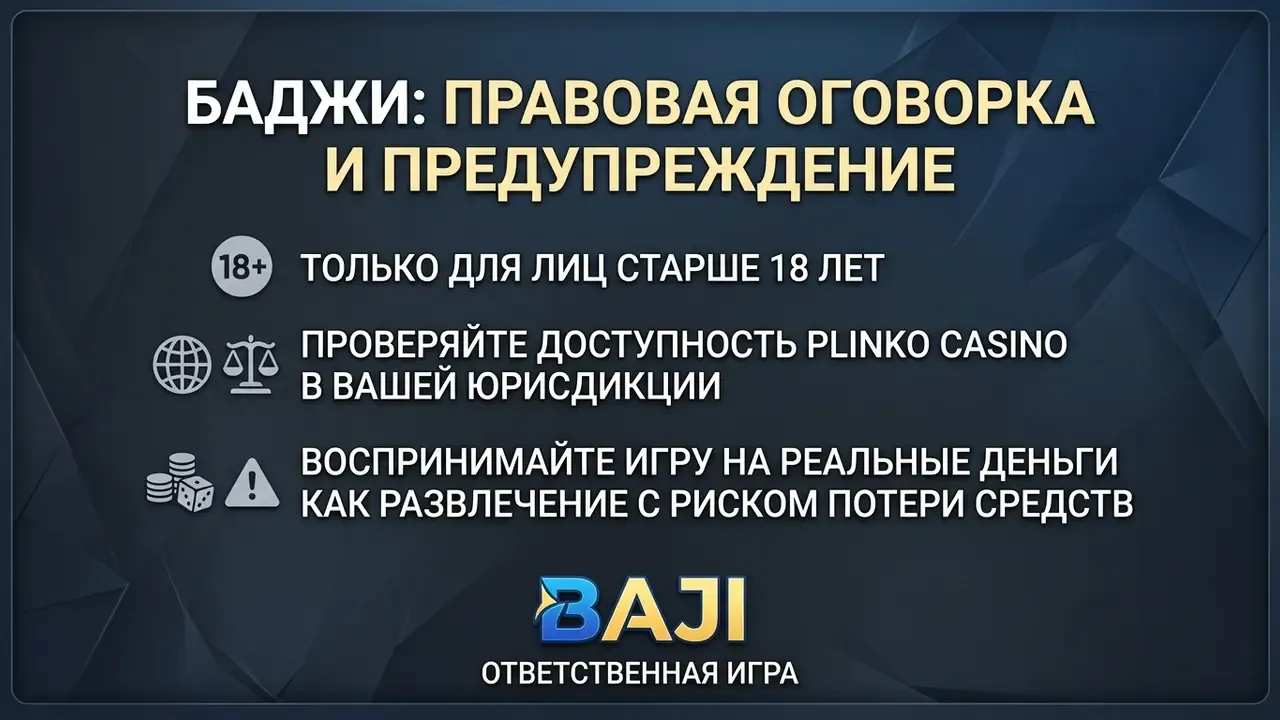
Disclaimer: The information here is general in nature and is not financial advice. Real-money gambling is for adults only and may be restricted or prohibited in your jurisdiction. There is a risk of losing your funds.

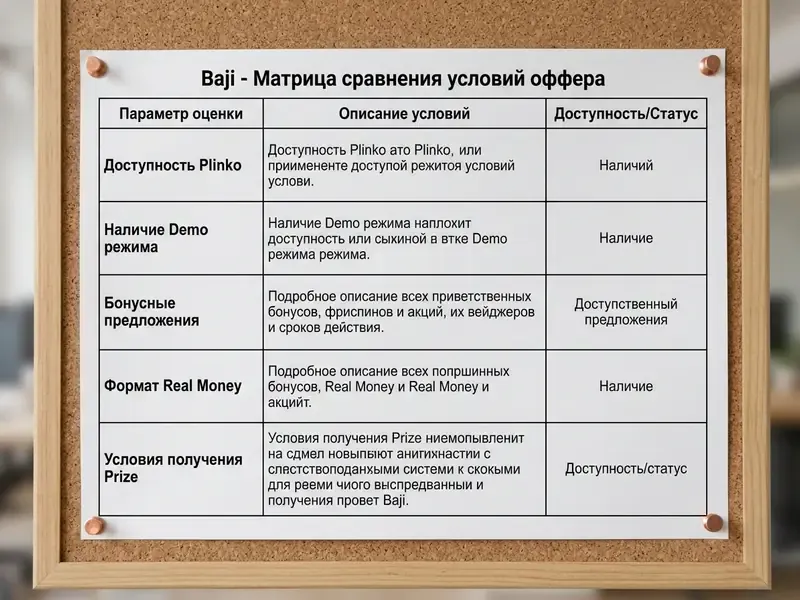
Key parameters to assess include theoretical RTP, risk modes and multiplier ranges. Beyond the game itself, judge the operator wrapper around it. Our editorial matrix of iGaming offer evaluation parameters runs six checks:

  1. Licence: verify the operator's licence number directly on the regulator's public register (UKGC, MGA or the applicable local authority), not on the casino's own footer badge. Licence validity is jurisdiction-specific.
  2. Original providers: is the Plinko supplied by BGaming, Spribe, SmartSoft, Hacksaw or Gaming Corps, or is it an unbranded clone with no published RTP?
  3. Published fairness: RNG certification or a provably fair verifier, with documented seed rotation.
  4. Demo availability: a licensed operator that hides demo mode is sending a signal, not saving screen space.
  5. Bonus terms: wagering requirement, game contribution percentage, max bet while wagering and withdrawal caps must all be stated. Missing or contradictory terms are unquantifiable risk.
  6. Withdrawal and KYC rules: processing windows, document requirements and limits, published before you deposit.
Key parameters to assess include theoretical

5.4 Sweepstakes Plinko: the US dual-currency model

In jurisdictions where conventional real-money casino play is restricted, most US states for example, Plinko is often distributed through the sweepstakes model, built on two separate currencies:

  • Gold Coins (GC): free entertainment currency, never redeemable for cash.
  • Sweeps Coins (SC): promotional coins obtained without purchase; once a playthrough requirement is met, they can be redeemed for cash prizes or gift cards.
PlatformWelcome offerPlaythroughPlinko variants
Stake.us260,000 GC + 55 Stake Cash (+ 5% rakeback)3xIn-house Plinko (99% RTP, up to 1,000x)
Sidepot.us10,000 Fliff Coins + 1 Fliff Cash1xClassic Plinko, XY Plinko, Multiplier Madness
Real Prize100,000 GC + 2 SC1xEaster Plinko, Pine of Plinko Bonus Slot
McLuck7,500 GC + 2.5 SC1xPlinko-themed slots (Pine of Plinko)
Jackpota7,500 GC + 2.5 SC1xPlinko, Xmas Plinko (Gaming Corps)

Two practical notes. First, playthrough differs: a 3x requirement on Stake Cash means every promotional coin must be wagered three times before redemption, which materially changes how much variance you have to survive. Second, sweepstakes availability is state-restricted and age-gated (18+ or 21+ depending on platform), and offers change frequently. Always re-read the current terms on the operator's own page. The promotional values above are indicative and need re-verification at the time of reading.

Educational and visualization uses

In two sentences: Plinko is one of the most effective physical analogies for teaching the binomial distribution. Beyond classrooms, the metaphor has been borrowed by data journalists to communicate forecast uncertainty.

6.1 Plinko in statistics teaching

Because a Plinko board makes an abstract distribution physically visible, it is a staple of probability instruction. Classroom studies using the PhET simulation report measurable learning gains and significant improvement in understanding the binomial distribution concept.

«Among 40 secondary-school students, using the PhET Plinko animation in collaborative learning produced an average 25% gain in scores at p < 0.01.» Study on applying PhET Plinko to teaching the binomial distribution (2023).

Larger, longer-running work points the same way, with a median Cohen's d around 1.0 to 1.1, considered a large effect in educational research.

«A multi-year Kazakh study recorded a median Cohen's d of ≈1.0–1.1, alongside higher intrinsic engagement and shorter time-to-class-mastery.» Kazakh dual case study on integrating PhET Plinko in grades 10 and 11.

6.2 Plinko as an uncertainty-visualization device

The board has also migrated into data visualization, borrowing the popular Plinko game from The Price Is Right and the Galton board's probabilistic foundations.

«In a longitudinal 2022 election study, a Plinko quantile dotplot was used to visualize gubernatorial forecasts across 33 states as a physical probability analogy.» Longitudinal study on election-forecast uncertainty visualization (2023).

The lesson transfers straight to gambling literacy. The same picture that helps a student grasp "the centre is where most outcomes live" also explains why the 1,000x bucket is decorative for almost every player.

In two sentences: Plinko strategy can only shape variance and session length, never expectation. Mobile delivery, local law and payment routing are the practical risks that most guides quietly skip.

7.1 Bankroll frameworks, not winning systems

Because the trajectory obeys probability (a Galton board), no guaranteed winning system exists. What row count, risk level and stake size do control is volatility: how fast your balance can swing and how long you last.

Framework 1, the "conservative accumulator" (low risk, 12 to 14 rows)

  • Goal: minimise drawdown and generate steady wagering turnover, useful when clearing a playthrough requirement.
  • Mechanics: central buckets return roughly 0.5x to 0.9x of stake, edges pay up to 10x to 16x. Full-balance wipeouts are unlikely in short sessions, but a slow bleed at 96% to 99% RTP is mathematically certain over time.

Framework 2, the "jackpot hunter" (high risk, 16 rows)

  • Goal: chase the maximum x1,000 multiplier.
  • Mechanics: central buckets pay just 0.2x; the extremes carry the four-digit multiplier. The measured probability of the top slot is roughly 1 in 32,768 per drop.
  • Bankroll rule: your balance should absorb at least 500 to 1,000 auto drops. With a $100 bankroll, that means a stake of about $0.10 per ball.

Why Martingale and its cousins fail here. RTP is expected return divided by amount wagered. At 96% RTP the expected loss is 4% of every unit staked, regardless of how those units are sequenced. Doubling after a loss raises the probability of a small win while creating a fat tail of catastrophic loss, constrained by table limits and bankroll. Flat betting keeps variance low but leaves the same negative drift. "Systematic risk switching" only reshuffles the distribution. Changing bet placement changes variance, not the house edge.

Test any bankroll rule in demo before it touches money. Run a fixed stake for 500 drops, log drops-until-zero, and note your longest losing streak. If your real-money plan cannot survive the worst streak you observed for free, it is not a plan. It is a hope.

7.1 Bankroll frameworks, not winning systems

7.2 Plinko on mobile: browser, PWA or download

Official Plinko pages are built in HTML5 and marked as playable on smartphone and tablet without a separate app. Practically, there are three delivery routes, and only one of them involves a download.

RouteHow it runsPractical notes
Mobile web (HTML5)Browser runtime, no installFastest to access; identical game logic and RTP to desktop
PWA (installable web app)Home-screen launch via browser engineFully installable on Android (Chrome / Trusted Web Activity); on iOS supported via Safari but with tighter WebKit limits on device APIs
Native app (download)Installed package, store updatesStore policies restrict real-money gambling apps in many regions; sweepstakes apps are more commonly distributed this way

A short note on downloads, since the question comes up constantly. Casino Plinko almost never requires one, and an "official Plinko download" pushed through a link outside Google Play or the App Store deserves suspicion, not curiosity. APK files from forums and messenger channels are a known vector for credential theft. If a game runs fine in a mobile browser, the download adds risk without adding features.

Updated framing of a common claim: it is often asserted that because mobile devices are accessible anywhere, players engage with Plinko more frequently or spontaneously. There is no Plinko-specific mobile behavioural dataset to support that, so treat it as an extrapolation from broader mobile-gambling literature rather than a verified finding about this game. Likewise, the general statement that platform ubiquity can increase exposure and risk is a plausible hypothesis drawn from wider gambling research. It currently lacks a Plinko-specific citation, and readers should treat it as a precaution rather than a measured effect. Concrete data on this point is still needed.

A short note on downloads, since

Payments. Mobile financial services such as bKash, Nagad and Rocket are not authorised gambling payment channels, and transactions identified as gambling-related can trigger wallet freezes, reversals or account closure. Crypto rails carry their own exposure: volatility, irreversible transfers and regulatory restrictions on cryptocurrency use in Bangladesh. Neither route offers chargeback protection comparable to regulated card payments. No responsible guide should promise "fast withdrawals" in that environment.

7.4 Sports media vs casino and iGaming: know what you are reading

Sports analysis (cricket, football)Plinko and other RNG games
Outcome driverHuman performance, form, conditions, team newsCertified random number generator
Can research improve accuracy?Yes, information has predictive valueNo, each drop is independent of history
Useful dataSquad news, pitch reports, head-to-headOnly RTP, volatility and paytable structure
What "history" tells youMeaningful trendsNothing about the next drop (zero memory effect)
Reader's riskReading analysis costs nothingReal-money play risks your deposit

If you arrived here from cricket or football coverage, hold this line: match analysis is information; Plinko is a probability distribution. A record table of previous rounds, which BGaming's build includes, is a log, not a signal.

Editorial view, Nadia Farzana Haque, Sports Editor: «We publish match context, squad news and explainers first. When a game like Plinko is explained, our job is to describe the math and the legal risk, not to sell a session.»

7.5 Responsible gaming and the myths worth killing

  • Myth: "the board is due for a big multiplier." Lab testing found zero memory effect across ten million drops. Past results do not tilt the next one, not even slightly.
  • Myth: "auto mode has better odds than manual." Mode affects speed and comfort, not distribution, and speed increases how much you wager per hour.
  • Myth: "99% RTP means I break even." A 99% RTP means a designed 1% loss on turnover. With 1,000 drops per session, turnover rather than stake determines expected loss.
  • Myth: "a strategy guide can guarantee profit." Any source promising guaranteed Plinko wins is selling variance as certainty.

Practical guardrails: set a deposit and loss limit before you open the game; use session timers; never chase losses with larger stakes; treat Plinko strictly as entertainment with a cost, not as income; and if play stops feeling optional, contact a licensed support service in your country.

7.5 Responsible gaming and the myths

Casual, arcade and idle Plinko variants

Not every Plinko is a wager. Understanding the non-gambling branch helps readers avoid conflating the two, which happens more often than you might expect.

Feature modifiers in commercial casino builds:

  • Multiballs:up to one multiball on the Nyx/BetMGM board, splitting a single drop into several scoring balls.
  • Cash Prizes:up to five fixed-value buckets injected into the board before the round.
  • Pushers:up to five deflector elements that alter routing. Combined with the Refresh button, they let the player re-roll board features and bucket values before dropping.
  • Coin Flip, Missions, Prize Drop, Leaderboards:SmartSoft's Plinko X engagement layer, designed to extend session length rather than change payout math.
8. Casual, arcade and idle Plinko

Arcade and idle builds:

  • The Price Is Right Plinko Pegs (Arkadium) adds walls, magnets and special pegs as pre-round upgrades, plus per-round objectives and a leaderboard. A skill-flavoured wrapper on a chance core, played for points.
  • PLINKO! by low effort inc (CrazyGames, released June 2026, HTML5, browser and app, rated 9.2) is a full idle game: a chunky cartoon field with a classic 1 to 10 row triangle, five stacking upgrades, a slot-levelling system, a Cash Out prestige system that earns permanent Shop Points, 10 Investment milestones with movable bonus pegs and multipliers (bonus pegs snap to existing pegs and can activate up to five times per ball), auto-drop and passive Shop Point generation.
  • Portals such as BrainPlay run browser Plinko with adjustable bet and ball count for points only, with no installation and no cash-out.

The functional difference is simple. In arcade builds, modifiers change ball trajectory or bucket level for points. In casino builds, modifiers change the payout distribution of real money.

Arcade and idle builds - The

FAQ: Plinko questions readers ask most

Appendix A: corrections and source notes

Correction 1, the 1956 / 1972 / 1983 confusion. Some Plinko pages imply the segment dates from the show's 1956 debut or from its 1972 format reset. The Price Is Right premiered in 1956 and adopted the One Bid, Pricing Games and Showcase Showdown structure in 1972, but the Plinko segment was first played on 3 January 1983. Legacy phrasing such as "First released in 1956… Since 1972… Plinko" is retained here only to identify the error; the corrected date is used throughout the article. (Updated.)

Correction 2, "no memory" versus "record tables." Provider marketing sometimes suggests a results board helps players "develop a winning strategy." A round-history table is useful for tracking turnover and volatility, but because drops are independent, it has no predictive value. The corrected reading is applied in Sections 3 and 7. (Updated.)

Open data gaps requiring further evidence. (1) No Plinko-specific behavioural study on player expectation during the ball's descent. (2) No Plinko-specific mobile-engagement study; statements about ubiquity and exposure are extrapolations. (3) No universal cross-provider probability for the 1,000x outcome. The figures cited here are tied to a specific 16-row high-risk simulation and to Spribe's documented tables.

Sources referenced in this article: Kozhevnikov & Renni-Likhachevskiy, ISJ Theoretical & Applied Science (2024); analytical study of the high-risk 16-row Plinko board (2026); BusinessHealth technical report on Plinko RTP and volatility (2025); comparative review of BGaming Plinko variants (November 2025); Spribe Plinko operator documentation; iTech Labs RNG certificate for Gametion Global Technologies (2024); UK Gambling Commission, Gambling Reform White Paper (2023); study on PhET Plinko and binomial-distribution learning (2023); Kazakh dual case study on PhET Plinko integration, grades 10 and 11; longitudinal study on election-forecast uncertainty visualization (2023); provider game pages and licence disclosures for BGaming (MGA/B2B/785/2020), SmartSoft (MGA/B2B/925/2021), Nyx/BetMGM and Gaming Corps; sweepstakes operator terms for Stake.us, Sidepot.us, Real Prize, McLuck and Jackpota.


Appendix A corrections and source notes

Final disclaimer: 18+ (21+ on some platforms). This material is informational and educational and is not legal, financial or gambling advice. Gambling laws differ by jurisdiction and may prohibit participation where you live. RTP is a long-run statistic and guarantees nothing in a single session. Play only with money you can afford to lose, and seek qualified help if gambling becomes a problem.