Aviator by Spribe: A Complete, Evidence-Based Guide to the Crash Game, Its Math, Demo Mode, Strategies and Where to Play

Written by the iGaming Research Desk · Editorial review: Nadia Farzana Haque, Sports Events Editor-in-Chief · Checked against provider documentation, public datasets and peer-reviewed gambling research · Last updated: February 2026

Our editorial team publishes long-form analytical work on casino mechanics, bonus economics and player-protection research. You can see the wider scope of our coverage in our iGaming research hub.

Responsible gambling notice. This article is informational and analytical. It is not financial advice, not a betting system, and not a promise of profit. Gambling involves the risk of losing money. Play only if you are of legal age in your jurisdiction (18+ or 21+ depending on the market) and only with money you can afford to lose.

Provider

Spribe

RTP

97.00%

Volatility

Medium

Min bet

$0.10

Max bet

$100

Max win

10,000x

Aviator by Spribe A Complete, Evidence-Based

What you actually need to know

  • Aviator is a social crash game released by the studio Spribe in 2019. Note the spelling: the developer is Spribe, not "Scribe", a typo that circulates even on large casino portals.
  • Declared RTP is 97.00%, which means a built-in house edge of roughly 3%. That edge is expressed openly as instant crashes at 1.00x rather than hidden inside an opaque reel cycle.
  • The maximum payout is capped: commonly 10,000x the stake or $10,000 per round, depending on the operator's paytable and currency. Claims of "up to 1,000,000x" that appear on some casino pages are unsupported and should be treated as marketing error.
  • Rounds are provably fair: the crash point is fixed cryptographically before the plane takes off, using a server seed plus client seeds hashed with SHA-256, verifiable in the round history.
  • Rounds are statistically independent. Autocorrelation analysis across 527,441 rounds found no relationship between any round and any other. So no predictor, signal bot or "pattern" can beat the game.
  • Real skill in Aviator is not prediction. It is bet sizing, auto-cashout discipline, bankroll limits and understanding bonus wagering terms before you deposit.
What you actually need to know

Quick orientation: the five numbers that decide your session

Before the long analysis, five figures do most of the explaining. Keep them in view while you read.

  1. 97.00% is the declared return to player. Nothing you do at the control panel changes it.
  2. ~10 seconds is the betting window. Short enough that impulse beats intention unless you pre-set your targets.
  3. ~49% is the approximate chance of a round reaching 2.00x. Half the time it does not.
  4. 3.4% of rounds in the largest public dataset went past 10.00x. Rare, and rarer than the highlight reels imply.
  5. 1 decision matters most: the multiplier at which you cash out, chosen before takeoff rather than during the climb.

That is the whole game in five lines. Everything below is the evidence.

Quick orientation the five numbers that

Empirical and technical foundations

In two sentences: Aviator belongs to a young gambling genre whose mathematics are unusually transparent, a continuous-time bet against a random stopping point, with a cryptographically committed outcome. Public datasets, cryptographic verification and peer-reviewed behavioural research now allow us to describe the game with numbers rather than adjectives.

1.1. Crash games as a distinct gambling format

A crash game is structurally different from a slot, a roulette wheel or a blackjack hand. In a slot, the outcome is resolved in a single instant and the player has no decision after pressing spin. In a crash game the player stakes before the round starts, then watches a multiplier grow from 1.00x, and the only meaningful decision is when to stop. The round ends at a random crash point, and if the player has not cashed out by then, the stake is lost.

This inverts the usual information relationship. Classic online games hide outcomes inside opaque random number generator (RNG) cycles; the player sees only the result. Crash games instead show the outcome unfolding in real time and expose the house edge as a visible event: the instant crash.

1.1. Crash games as a distinct

"The authors computed theoretical expected values for crash bets and found that extremely high multipliers are statistically rare, while long-run return converges on the theoretical house advantage." Scott, Sher et al., Cash or Crash (2023–2024)

Formally, Aviator is best described not as a discrete wager but as a continuous-time gamble in which the player's decision point (cash out) interacts with an exogenous crash process.

"Crash multipliers are modelled by heavy-tailed distributions; the mechanic is a continuous-time bet with no deterministic upper bound." Quantitative Modeling of Multiplier Distributions in Crash Games, arXiv (2026)

Two practical consequences follow. First, the variance of your results is under your control (a 1.2x target produces frequent small wins; a 20x target produces rare large ones). Second, the expected value is not under your control, because it is fixed by the RTP.

1.2. Provably fair randomization and verifiable game outcomes

Aviator's fairness model borrows from blockchain gaming rather than from classical certified-RNG casino design. The crash point for a round is derived from a server seed generated by Spribe and combined with client seeds contributed by players; in Aviator's implementation, the first three players who place a bet in the round. The combined value is hashed with SHA-256, and the resulting hash is published so the round cannot be altered retroactively without invalidating the cryptographic hash.

"Hash values from 150 rounds matched the declared crash points: the crash point is mathematically fixed at the moment the round begins." Everly Family, independent Aviator analysis (2024)

The underlying design principle is the same one used by verifiable random functions in on-chain gaming:

"The contract defines validation criteria for an as-yet-unknown random number; once generated, the value is verified and executed in accordance with those criteria." Building Random, Fair, and Verifiable Games on Blockchain, arXiv (2023)

How to verify a round yourself (step by step):

  1. Open the round history panel (the list of past multipliers at the top of the game screen).
  2. Click a specific round to expand its details.
  3. Copy the server seed, the three client seeds and the combined hash.
  4. Paste the concatenated seeds into any public SHA-256 calculator.
  5. Compare the resulting hash to the hash stored in the round record. If they match, the crash point was pre-committed and could not have been changed after your bet.

This is why the phrase "provably fair" is not a slogan in Aviator's case. It is a property you can test with a hash calculator in under a minute. Do it once, and predictor marketing loses most of its power over you.

How to verify a round yourself

1.3. Multiplier distributions and empirical datasets

Because crash results are public, the genre can be audited at scale. The largest published Aviator dataset we could locate covers more than half a million rounds and shows a distribution with a dense mass of low multipliers and a thin tail of rare, high-payoff events.

"Of 527,441 rounds, 28.2% ended between 1.10× and 1.50×; only 3.4% exceeded 10.00×; the distribution is strongly right-skewed." Aviator Game Prediction India: Data Science Approach to Crash Games, NCDIP (2026)

A useful editorial caveat. A simple 97% RTP crash model predicts that roughly 9.7% of rounds should exceed 10x (approximately 0.97 ÷ 10). The observed 3.4% is materially lower, which suggests either an operator-specific configuration, a filtered sample, or a distribution shape that is not the textbook exponential. This gap requires further verification against provider-side data, and we flag it rather than smoothing it over. Either way, the direction of the finding is unambiguous: high multipliers are far rarer than highlight clips suggest.

Theoretical reach probabilities under a 97% RTP crash model (approximate, for orientation, not a guarantee):

A useful editorial caveat. A simple
Target multiplierApprox. chance of reaching itApprox. chance of crashing firstExpected value per 1 unit staked
1.10x~88%~12%0.97
1.20x~81%~19%0.97
1.30x~75%~25%0.97
1.50x~65%~35%0.97
2.00x~49%~51%0.97
3.00x~32%~68%0.97
5.00x~19%~81%0.97
10.00x~10%~90%0.97
100.00x~1%~99%0.97

The final column is the entire lesson of the table: every target produces the same expected value. Cash-out choice moves your variance, not your edge.

1.4. Independence of rounds and impossibility of prediction

Players routinely believe that a long run of low multipliers "owes" them a big one, or that two consecutive 50x results mean the game is "cold" for the next ten rounds. This intuition is unfounded.

"The exponential multiplier distribution in Aviator is memoryless: at any point in a session, the remaining distribution of outcomes is identical regardless of history." Aviator Game Prediction India: Data Science Approach to Crash Games, NCDIP (2026)

Streaks certainly occur, since they are a mathematical necessity in any random sequence, but the streaks are statistically indistinguishable from pure chance.

"The probability of reaching 2× in the next round is the same 49%, regardless of whether the previous crash occurred at 1.02× or at 87×." Aviator Patterns analysis, 10,000 consecutive rounds (2023–2026)

In two sentences: Aviator is a multiplayer crash game where a plane climbs, a multiplier rises from 1.00x, and you cash out before it flies away. Its popularity comes from three things classic slots lack: an active decision, a shared social round, and radical transparency about the odds.

2.1. Core mechanics: bets, rising multipliers, and crashes

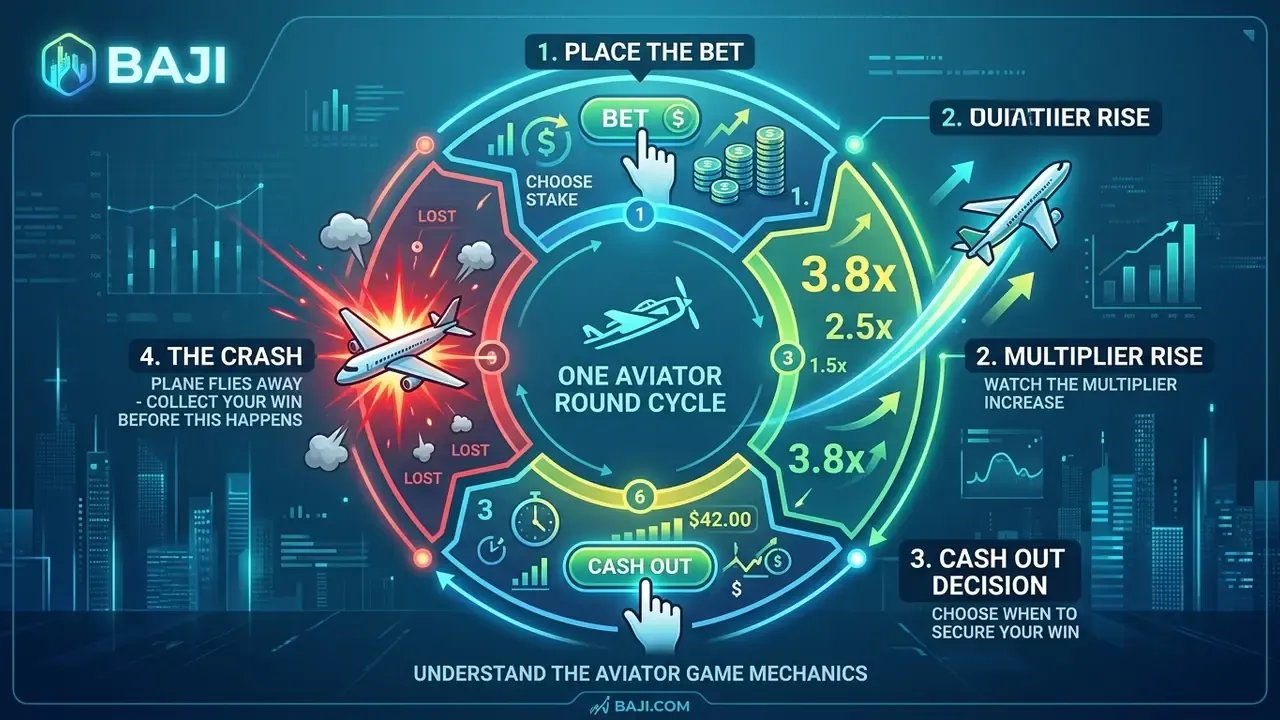
The round cycle is fixed and short:

  1. Betting window opens, roughly 10 seconds to place one or two bets.
  2. Takeoff, the plane launches and the multiplier begins climbing from 1.00x.
  3. Growth phase, the multiplier accelerates; the longer it runs, the higher the payout and the higher the risk.
  4. Resolution: either you press Cash Out and lock the current multiplier (stake × multiplier), or the plane flies away and the stake is lost.

Crucially, a portion of rounds end immediately at 1.00x, which is a visible expression of the house advantage rather than a hidden parameter in a black-box RNG.

2.1. Core mechanics bets, rising multipliers

"Around 3% of rounds end in an instant crash at 1.00×; AviatorStats records 5.5% of such rounds, a direct expression of the roughly three-percent house edge." CrashGames Guide, Aviator review (2026); AviatorStats.com

The spread between those two figures (3% vs 5.5%) again illustrates why single-source numbers should be treated as estimates: samples differ by operator, period and data-collection method.

Key technical parameters at a glance:

ParameterValue
DeveloperSpribe (not "Scribe")
Release year2019
Game typeSocial crash game, multiplayer
Declared RTP97.00%
House edge~3%
Multiplier rangeFrom 1.00x upward
Maximum winCommonly 10,000x or $10,000 per round, operator-dependent
Fairness modelProvably Fair (server seed + client seeds, SHA-256)
TechnologyHTML5, mobile-first, portrait and landscape
Betting window~10 seconds per round
Simultaneous betsUp to 2 per round
Social featuresLive chat, live bet feed, leaderboards, "rain" promos at some operators

2.2. Interface and social layer

Aviator's screen is deliberately minimal: the flight animation, a scrolling history of past multipliers, a live bets panel showing other players' stakes and cash-out points, a leaderboard, and a live chat. Some operators enable in-chat "rain" giveaways where players distribute small amounts to the room.

This matters commercially. In an era where social media shapes leisure behaviour, a game with a shared round and a chat window turns online casino play from an isolated single-player activity into a collective event with banter, visible risk-taking by others, and social proof.

It also introduces a behavioural risk the marketing rarely mentions. Watching another player ride a round to 40x is a powerful nudge to abandon your own plan. Treat the live-bets panel as entertainment, not as information. One more thing: the leaderboard shows winners, never the size of the losing crowd behind them.

2.2. Interface and social layer. Aviator's

2.3. Popularity and market penetration

Aviator did not merely succeed; it defined a genre. Newer crash providers tend to copy its core mechanic innovations, such as dual bets, auto-cashout, chat and provably fair verification, rather than reinvent them.

"By April 2026 Aviator had reached roughly 77 million monthly active users, more than 5,500 licensed integrations and approximately 90% share of the crash genre by player count." CrashGames Guide, Aviator history deep dive (2026)

These are industry-side estimates rather than audited financials, so they should be read as scale indicators. The structural point stands: when a single title holds a dominant share of a genre, its parameters (97% RTP, roughly 10-second rounds, provably fair verification) become the de facto standard that competitors are benchmarked against.

Popularity is also geographic. In South Asian markets, including Bangladesh, crash titles travel well because they are light on data, readable on a small screen and understandable within one round. That accessibility is a genuine product strength and, at the same time, a reason to read the legal section below carefully.

These are industry-side estimates rather than

Access paths: casinos, bonuses and wagering terms

In two sentences: Aviator is only available through operators that license it from Spribe, and the game itself is identical everywhere; what differs is the casino's bonus terms, deposit minimums, payout speed and payment rails. That is where almost all of the real financial variance for a player lives.

3.1. Playing Aviator in online casinos and betting sites

Because the game is delivered by the provider, the mathematical model does not change from site to site: the RTP should be 97 percent regardless of the casino or betting site. What you are actually choosing when you pick a venue is the wrapper: licensing, KYC friction, deposit and withdrawal rails, cashback structure, and how quickly money leaves the account.

How to verify an operator before depositing (six checks):

  1. Licence. A current authorisation from a recognised regulator, with licence number and issuing authority stated in the footer or terms. A game can be legal in one country and unauthorised in another, since licensing and consumer-protection rules are jurisdiction-specific.
  2. Genuine Spribe software. The provider list must name Spribe. Unbranded "Aviator" clones from unknown studios are a different product with different maths and no verifiable hash history.
  3. Published payout rules. Processing time, withdrawal limits, supported methods, and whether withdrawals are handled instantly, within hours, or in 24–48 hours.
  4. Payment networks. For crypto, confirm which networks are supported (TRC-20, ERC-20, BEP-20). The wrong network is the single most common cause of lost deposits, and network fees differ by an order of magnitude.
  5. Data protection. A published privacy and security policy describing how personal and payment data are stored and protected.
  6. Responsible-gambling tools. Deposit limits, loss limits, session limits, cooling-off and self-exclusion. The European Gaming and Betting Association's responsible-gambling code treats these as baseline operator obligations, and the UK Gambling Commission's consumer guidance advises setting a deposit limit before playing.

Aviator is a digital-native title: it exists in licensed online casinos and sportsbook lobbies, not on physical casino floors.

A jurisdictional note for readers in restrictive markets. In Bangladesh, gambling is governed largely by the Public Gambling Act of 1867 and related provisions, which predate the internet entirely. Online play sits in a legally uncertain zone, and enforcement, site blocking and payment restrictions can all change without notice. Practical consequences are mundane rather than dramatic: card declines, frozen local payment channels, KYC requests you cannot satisfy, and withdrawals stuck in review. Before you treat any offer as available, check the operator's list of restricted countries and your own legal position. Where the law is unclear, the cautious reading is the sensible one. This paragraph is general information, not legal advice.

3.1. Playing Aviator in online casinos

3.2. Casino bonuses, wagering requirements, and Aviator eligibility

Bonus terms, not the game, determine whether a promotion is worth claiming. Three structural issues recur with crash games specifically:

  • Free spins usually do not apply. Free spins are tied to slots. Aviator is not a slot, so free spins are only usable on Aviator if the terms explicitly include crash games or "all games".
  • Free bets are sportsbook instruments. Their turnover is calculated under sportsbook rules; Aviator is generally not free-bet eligible unless the operator states otherwise.
  • Game contribution is often reduced or zero. Many operators weight crash games at a fraction of slot contribution toward wagering, or exclude them entirely, precisely because a 1.01x auto-cashout strategy is a low-variance way to churn turnover.

There is also a design detail worth noting for anyone modelling bonus abuse or player behaviour. In reviewed bonus-churn patterns, cash-out targets clustered tightly around minimum thresholds, suggesting that players did not adjust their behaviour in response to higher or lower multipliers.

And the deeper problem is comprehension. In a large randomised controlled trial, most participants could not compute what a bonus actually required of them:

3.2. Casino bonuses, wagering requirements, and

"Seven in ten participants could not calculate wagering requirements; when a bonus was combined with a deposit, the share rose to nine in ten, and most seriously underestimated the turnover needed." Behavioural Insights Team (BIT), randomised controlled trial, 4,012 participants (2024); summarised by CardPlayer Lifestyle

A worked wagering example. Deposit $100 with a 100% match and a 40x wagering requirement applied to deposit plus bonus: 40 × ($100 + $100) = $8,000 of turnover. At 3% house edge on a fully contributing game, the expected cost of clearing that turnover is roughly $240, more than the $100 bonus is worth. If crash games contribute at 20%, you would need $40,000 of Aviator turnover to satisfy the same requirement. This arithmetic, not the headline percentage, is the bonus.

The seven terms to check before activating any promotion:

  1. Eligibility: new players only, account status, duplicate-account rules.
  2. Jurisdiction: excluded countries and restricted currencies.
  3. Game restrictions: is Aviator eligible, and at what contribution rate?
  4. Wagering requirement: the multiple, and whether it applies to bonus only or deposit plus bonus.
  5. Maximum bet while wagering: commonly $5 or less; breaching it can void winnings.
  6. Withdrawal or max-cashout cap: a "$25,000 bonus" with a $4,000 max cashout is a $4,000 bonus.
  7. Expiry and KYC triggers: how many days you have, and when identity verification will freeze withdrawals.
A worked wagering example. Deposit 100

Fact check before you register. Bonus percentages, wagering multiples, Aviator availability and country restrictions change frequently and without announcement. Verify every figure on the operator's own bonus and terms pages at the moment you sign up. Our tables describe publicly advertised offers on the date of writing, nothing more.

3.3. Comparison of casinos offering Aviator and crash-style games

The table below compares widely promoted crypto-friendly venues that carry Aviator or Aviator-style crash titles. Terms change frequently, so always re-read the current bonus page and licence details on the operator's own site before depositing. Figures reflect publicly advertised offers at the time of writing.

CasinoWelcome offer (1st deposit)WageringMin. depositPayout speedCrypto supportCrash titles
Lucky Rollers100% up to 30,000 USDT + 100 FS + 1 free bet40x$5Instant13 incl. BTC, ETH, BNB, DOGE, LTC, USDT3
Betpanda.io100% up to 1 BTC + 10% weekly cashback66x$1Up to 24h30+ incl. BTC, ETH, USDT, USDC, XRP, LTC, ADA4
CoinCasino200% up to $30,00060x$10Up to 24h13 incl. BTC, ETH, USDT, SOL, BNB, XRP, DOGE5
Cryptorino100% up to 1 BTC + 10% weekly cashback66x€10Up to 24h16 incl. BTC, BNB, USDT, XMR, ETH, DOGE, LTC4
Hyper Lucky20% daily cashback up to $10,000 + 100 FSn/a$101–24h11 incl. BTC, BNB, USDT, XRP, ETH, ADA, LTC3
CasinoPunkzUp to 20,000 USDT + 15% cashback80x (staged)$201–48h13 incl. BTC, ETH, USDT, SOL, LTC, BNB, ADA4
ThrillUp to 70% rakeback + 10% cashbackn/a$1Instant14 incl. BTC, ETH, BNB, SOL, LTC, USDC3
BC.GameFour match bonuses up to $4,000 + 400 FS20x (bonus) / 40x (FS)$1Up to 24h140+ incl. BTC, ETH, BNB, SOL, XRP, USDT5
Wild.ioUp to 350% across first 3 deposits + 200 FS40x$5Up to 24h12 incl. BTC, ETH, XRP, USDT, USDC, DOGE4
VaveUp to 4 BTC + 100 FS + 5% cashback40x$5Up to 24h11 incl. BTC, ETH, BNB, DOGE, LTC, USDT3
Cybet100% up to $1,000 + 50 FS40x$10Up to 24hMajor coins3
Betplay.io100% up to 5,000 USDT80x$5Up to 24hMajor coins3
Lucky Block200% up to $25,000 + 50 FS60x (staged)$5Up to 24hMajor coins4
TG Casino200% up to 10 ETH + 50 FS60x (staged)$25Up to 24hMajor coins + Telegram wallet3
Crypto Games200% welcome boost up to $20,00040x$5Up to 24hMajor coins3

How to read this table. Low minimum deposit plus instant payout plus wager-free cashback is usually a better real-money proposition than a headline "350% up to $30,000" attached to 60–80x turnover. Staged bonuses, released in 10% increments as you wager, are safer than all-or-nothing bonuses because you keep partial value if you stop early.

Gameplay dynamics: the control panel and cash out

In two sentences: Aviator's control panel is small but consequential, since dual bets, auto-bet and auto-cashout let you pre-commit a plan and remove the reflex problem entirely. The same cash-out mechanic that makes the game feel skilful is also the feature most strongly associated with harmful play in the research literature.

4.1. The control panel: single bet, dual bets, auto-bet and auto-cashout

Step-by-step: your first Aviator round.

  1. Open the game at a licensed operator and confirm you are in the correct mode (Demo or Real). The mode indicator sits near the balance.
  2. Set the stake. Use the preset chips or type a custom amount. Start at the table minimum, often $0.10, while you learn the rhythm.
  3. Choose one or two bets. The panel can be split into Bet 1 and Bet 2, each with independent stake and independent cash-out. Two bets are the foundation of hedging (see 6.1).
  4. Enable Auto Cash Out and enter a target multiplier, for example 1.35x. The system will close the bet automatically at that value. This removes reaction-time risk and, more importantly, removes the emotional decision.
  5. Optionally enable Auto Bet. The panel will re-stake the same amount every round without you touching it. Because the betting window is only about 10 seconds, auto-bet is also the practical way to avoid missing rounds.
  6. Watch the round. The multiplier climbs from 1.00x. If you did not set an auto-cashout, press Cash Out manually.
  7. Confirm the result. A green confirmation shows the multiplier achieved and the amount credited; the round appears in your history with its hash.
  8. Check the balance after the round to confirm the credit, then verify the round in the provably fair panel if you want to audit it.
  9. Withdraw deliberately. Set a session profit point in advance and withdraw to your wallet rather than letting a win sit in the casino balance.

[MEDIA PLACEHOLDER: numbered first-round checklist. Short instruction set covering open the aviator game, choose the bet, watch the multipliers, use cash out, check the result. Purpose: close the practical "how do I start" intent in a scannable format. Semantic markup rules: use an ordered list; every step must exist as text in the DOM and must not be replaced by an image.]

Practical auto-cashout settings by intent:

4.1. The control panel single bet
IntentAuto-cashout targetExpected hit rateTypical use
Turnover / low variance1.10x–1.20x~81–88%Grinding low-volatility sessions
Balanced1.30x–1.50x~65–75%Standard recreational play
Growth2.00x–3.00x~32–49%Longer drawdowns accepted
Tail hunting10x+~10% or lessSmall stakes only

There is no "correct" row. Every row has the same 97% expected return; they differ only in how brutally the variance arrives.

4.2. Cash-out features and behavioural risks

The cash-out button is the emotional core of the game, and the research on cash-out mechanics in adjacent gambling formats is not reassuring. In a study of adults who bet in-play, cash-out use was widespread and associated with worse psychological profiles, alongside younger age and stronger motivations to gamble in order to make money.

"51.8% of participants used the cash-out feature; they showed higher levels of depression, anxiety, stress and substance misuse." Addictive Behaviors study, 224 Ontario adults (2024); PubMed

A related conference analysis examined a larger sample and reached a similar conclusion, identifying cash-out as a feature that warrants specific attention rather than a neutral convenience, and as potentially contributing to harm in vulnerable individuals.

"Among 929 participants, 224 used cash out; they were younger and more heavily engaged in in-play betting, and cash out was identified as a particularly harmful activity." Siu, Lin & Sinclair, New Horizons in Responsible Gambling Conference (2023)

These studies concern sports in-play cash out, not Aviator specifically, so the transfer is analogical rather than proven. But the structural similarity is strong: a continuously updating value, a live decision under time pressure, and the feeling of exercising skill over an outcome that remains random. Pre-committing an auto-cashout target is, in this light, not just a convenience feature but a harm-reduction tool.

"A sports desk should describe features honestly, including the ones that sell well. Cash out feels like control. In a random process it is mostly a comfort mechanism, and readers deserve to hear that plainly." Nadia Farzana Haque, Sports Events Editor-in-Chief

4.3. Nudging withdrawals and cash-out control

If the risk is that money never leaves the account, one evidence-backed countermeasure is prompting withdrawals.

"Personalised messages prompted players to withdraw larger amounts from their online casino accounts compared with a control group." Auer & Griffiths, Nudging online gamblers to withdraw money, Journal of Gambling Studies (2023)

Practically, you can self-nudge. Set a rule such as "any balance above 150% of my deposit is withdrawn the same day", and act on it before opening the next round. Crash games make this easier than slots because sessions are naturally divided into discrete 10-second cycles. Every round is an exit point.

Demo play versus real-money Aviator

In two sentences: Demo mode is genuinely useful for learning the interface, the round rhythm and the auto functions with zero financial exposure. It is misleading in exactly one respect: it cannot teach you how you will behave when the money is real.

5.1. What Aviator demo is good for

Aviator demo runs on a virtual balance. The gameplay loop, the multiplier behaviour and the panel are the same; only the money is fictional. Best uses:
  • Learning mechanics:the 10-second window, takeoff timing, how the multiplier accelerates.
  • Testing auto functions:run 100 rounds of auto-bet with auto-cashout at 1.30x and observe drawdown patterns before risking anything.
  • Interface familiarisation:locating cash out, dual bets, history, hash verification and settings without time pressure.
  • Sanity-checking a "strategy":most staking systems reveal their failure mode within a few hundred demo rounds.
5.1. What Aviator demo is good

Aviator free play is intended to let players acquaint themselves with the game without risking money, and the underlying RNG and RTP are typically identical to real-money mode. We should be careful here, though: we found no independent study verifying parity between demo and real-money configurations across operators, so this should be treated as the industry norm rather than a certified fact. If parity matters to you, verify the round hashes in demo mode the same way you would with real money.

5.2. Transition to real-money play and risk perception

Demo results are not predictive. Because the underlying random process and declared house edge are the same, a winning demo streak reflects variance, not acquired skill, and we state this as a mathematical inference rather than as a directly measured research finding.

What does change is you. Real money introduces loss aversion, sunk-cost reasoning and the urge to chase, none of which appear when the balance is fictional.

"Feelings of depression, anxiety and stress correlate with cash-out use; immediate access to money is the primary motive, and that motive intensifies under real stakes." Addictive Behaviors study, 224 participants (2024); PubMed

Rules that hold the line at the transition point:

  • Set a deposit limit before your first real round, not after your first loss.
  • Fix a stake size as a fraction of bankroll (commonly 0.5–2% per round) and do not change it mid-session.
  • Never raise stakes to recover losses. This is the single most consistent instruction across regulator guidance and operator responsible-gaming policies.
  • Use cooling-off mechanics. Some operators lock self-imposed deposit limits so they cannot be raised until the next cooling-off period elapses. Choose those operators.

5.3. Responsible-gambling considerations and limitations of demo play

Demo mode can create a distorted picture of both volatility and bonus economics. This section is general information and does not replace consultation with a problem-gambling specialist.

The specific hazard is bonus expectation. A player who has cleared imaginary turnover in demo mode may enter real-money play with unrealistic expectations about how quickly they can convert bonuses through Aviator.

"Nine in ten players seriously underestimated the amount of wagering required to satisfy the requirement when a bonus was combined with a deposit." Behavioural Insights Team (BIT), 4,012 participants (2024)

Demo mode also omits the frictions that shape real sessions: KYC checks, withdrawal processing times, network fees, maximum-bet-while-wagering clauses, and the emotional weight of watching a real balance fall through a 25-round losing sequence. If you want demo play to be genuinely instructive, simulate those constraints deliberately. Cap your virtual bankroll, cap your session length, and stop when the rules say stop.

Disclaimer, responsible gaming. Gambling carries a real risk of financial loss. Results in aviator demo do not indicate, forecast or guarantee results with aviator real money. Play only if you have reached the legal age in your jurisdiction, only within a personal limit you set in advance, and never with borrowed money. If gambling has stopped being entertainment, contact a national problem-gambling helpline or use the operator's self-exclusion tools.

Strategies, bankroll management and the limits of prediction

Disclaimer. The information below is general in nature and is not financial advice or a guide to generating profit. Gambling carries the risk of losing funds. No staking system changes the mathematical expectation of the game.

In two sentences: Aviator strategies are variance-management tools, not edge-creation tools; the honest goal is to control session length and drawdown, not to beat 97% RTP. Anything marketed as a predictor is, cryptographically and statistically, impossible.

6.1. Approaches to stake size and cash out

Strategy 1, minimum risk (low volatility). Auto-cashout at 1.20x–1.30x, flat stake of 1% of bankroll. Hit rate roughly 75–81%. This produces long sequences of small wins punctuated by clusters of losses. Because each win adds only 20–30% of stake while each loss costs 100%, four consecutive losses wipe out roughly 13–17 wins. Realistic use: extending session time, satisfying turnover where crash games contribute fully, and learning discipline.

Strategy 2, dual bet or hedge. Split the stake across Bet 1 and Bet 2. Set Bet 1 to auto-cashout at 1.50x and hold Bet 2 for a higher target such as 5.00x+. Worked example with two $10 bets ($20 total exposure): if Bet 1 closes at 2.00x it returns $20 and neutralises the round's cost, converting Bet 2 into a "free-roll" on the tail. If you use 1.50x on Bet 1, it returns $15 and recovers 75% of total exposure. The hedge does not raise expected value, since the combined EV is still 0.97 per unit, but it dramatically reduces the frequency of fully losing rounds, which is what most players actually experience as "control".

Strategy 3, moderate risk with fixed stop rules. Auto-cashout at 1.80x–2.20x (roughly 44–54% hit rate) with a hard stop-loss at 20% of bankroll and a stop-win at 30%. The stop rules are the strategy; the multiplier target is cosmetic.

Why Martingale fails here. Doubling after each loss at a 2.00x target requires surviving loss streaks whose probability is small but far from negligible. With a roughly 51% loss rate per round, an eight-loss run occurs about once in every 200 sequences, and it demands a stake of 256 units to continue. Over a 500-round session, such runs are expected rather than exceptional. Add the operator's maximum bet limit and a finite bankroll, and the system converts a series of small wins into one catastrophic loss. A Martingale approach in Aviator can therefore escalate to very large bets after a sequence of instant crashes, a conclusion that follows from the arithmetic of bet doubling under a finite bankroll rather than from a dedicated published study of Aviator specifically.

Strategy comparison:

6.1. Approaches to stake size and
StrategyTargetApprox. hit rateDrawdown profileExpected value
Minimum risk1.20x–1.30x75–81%Frequent small wins, sharp loss clusters0.97
Dual bet hedge1.50x + 5.00xMixedFew total-loss rounds, capped upside on leg 10.97
Moderate + stops1.80x–2.20x44–54%Medium swings, bounded by stop rules0.97
Martingale2.00x, doubling49% per roundRuin risk on ~8-loss run0.97 (before ruin)
Tail hunting10x–100x1–10%Long dry spells, rare large hits0.97

6.2. Why no strategy guarantees money: pattern-based prediction and "predictor" tools

A commercial ecosystem sells Aviator "signals", "hack APKs", "prediction bots" and paid Telegram channels. None have demonstrated predictive accuracy above chance in properly controlled studies.

"Autocorrelation coefficients across all lags from 1 to 100 are indistinguishable from zero; all p-values exceed 0.1, so no round is statistically related to any other." Aviator Game Prediction India: Data Science Approach to Crash Games, NCDIP, 527,441 rounds (2026)

Any apparent success is explainable as random variance rather than as proof of predictive power. And the cryptographic layer closes the door completely:

"No tool reads Spribe's RNG, because it is not externally accessible. This is not marketing language but a verifiable cryptographic property." Everly Family, independent Aviator analysis (2024)

Two practical warnings. First, "predictor" apps are a standard malware vector: they are distributed as sideloaded APKs requesting overlay, accessibility and account permissions. Second, using third-party automation frequently breaches operator terms and can void balances and bonuses.

So what can a strategy actually deliver? Session shape. Nothing else. Methods change how fast your bankroll moves, not where it is heading over thousands of rounds. Anyone promising otherwise is selling something.

6.3. Strategic tips grounded in harm reduction

Since edge is unavailable, the only defensible optimisation targets are cost control and exposure control:

  1. Pre-commit everything. Stake, auto-cashout target, stop-loss and stop-win, decided before the first round.
  2. Bet flat. Progression systems increase ruin probability without improving expectation.
  3. Cap session length, not just session losses. Time-on-device predicts spend.
  4. Withdraw on a rule, not on a feeling. Because operators and players should both be attentive to psychological risk factors, an automatic withdrawal rule beats discretionary judgement mid-session.
6.3. Strategic tips grounded in harm

"Personalised messages increase the amounts online casino players withdraw from their accounts, a potential harm-reduction instrument adaptable to crash games." Auer & Griffiths, Journal of Gambling Studies (2023)

  1. Prefer wager-free cashback to large matched bonuses, especially if crash games are weighted below 100% toward turnover.
  2. Verify a round occasionally. The habit of hashing a round yourself is a good antidote to conspiracy thinking and to predictor marketing alike.

Aviator mobile and download: playing from a phone

In two sentences: Aviator is built HTML5-first, so the browser version is fully functional on phones and no download is required. Official store apps are acceptable; third-party APKs promising Aviator hacks are the main security threat in this niche.

7.1. Aviator on mobile devices and app ecosystems

There are three access routes, in descending order of safety:

  1. Responsive web. iOS Safari and Android Chrome both support responsive web apps built on a single codebase with viewport adaptation, so aviator online runs in the browser without installation. This is the default and the safest path.
  2. Official operator apps. Distributed through the App Store or Google Play, or, on Android, other distribution channels that comply with platform policy. Store review provides a baseline integrity check, and an aviator download of this kind is tied to the operator, not to the game itself.
  3. Third-party APKs. A sideloaded APK bypasses store review. Google Play Protect primarily scans apps installed from Play and warns about malware and potentially unwanted applications; a manually installed "Aviator predictor" sits outside that protection. Avoid entirely.

Practical mobile notes: the game is playable in portrait and landscape, it is light on bandwidth compared with 3D slots, and on a weak connection the risk is not unfairness but a missed manual cash out. That alone is a good argument for auto-cashout on mobile.

Mobile access also has a behavioural dimension. General gambling research suggests that mobile access can increase the frequency and convenience of play, potentially leading to longer sessions and higher exposure. We flag this as a plausible mechanism that requires further data specific to crash games, since we did not locate a controlled study measuring session-length effects for Aviator on mobile. Regardless, device-level screen-time limits and operator session limits are cheap insurance.

7.1. Aviator on mobile devices and

7.2. Fairness, trust, and regulatory context

Two fairness regimes coexist in this game. The regulatory regime requires that outcomes come from an RNG tested for unpredictability and statistical independence, certified by an independent laboratory, with scope and standards varying by jurisdiction. The cryptographic regime is Aviator's provably fair layer, and players can validate this property themselves.

"VRFs guarantee that random values are unknown and unpredictable at the moment of commitment yet verifiable afterwards, exactly the model Aviator implements." Building Random, Fair, and Verifiable Games on Blockchain, arXiv (2023)

The combination is unusually strong for a casino product: an external certificate plus a per-round proof. It does not, however, change the house edge. A provably fair game with 97% RTP is provably a 3%-edge game.

7.3. Similar games and comparative mechanics

GameProviderVisual themeDistinctive features
AviatorSpribeRed plane, minimal HUDDual bets, live chat, leaderboards, provably fair, 97% RTP
JetXSmartSoftSpace and jet takeoffClassic crash cash-out; strong emerging-market distribution
Lucky JetPocket Games SoftRed-suited jetpack characterAuto cash-out, stop-loss and take-profit controls
SpacemanPragmatic PlayCartoon astronautInstant cash-out and partial cash-out options; no free spins

Provider attributions follow the operator catalogues and supplier listings we reviewed; a few markets list regional distributors instead of the originating studio, so confirm the provider label inside the game lobby.

Across the genre the promise is identical, namely to turn a stake into a multiple of itself within seconds, and so is the constraint: such outcomes are rare.

"Crash games offer the possibility of multiplying a stake many times over, yet such outcomes are statistically rare and long-run return corresponds to the theoretical house advantage." Scott, Sher et al., Cash or Crash (2023–2024)

The practical differentiators are therefore not mathematical but experiential: round pacing, control-panel depth, availability of partial cash-out, quality of the social layer, and whether the operator's version supports hash verification.

FAQ about Aviator

Fact-check: common claims about Aviator

Claim seen in circulationVerdictCorrection
"Coefficients rise as high as 1,000,000x."Contradictory / unverifiedStandard Spribe configuration caps payouts at 10,000x or $10,000 per round. Publishing 1,000,000x without operator-specific rules misleads players.
"An all-round job by Scribe."Typo / factual errorThe developer is Spribe.
"RTP of 97.00%."SupportedMatches Spribe's declared parameter and is corroborated across independent reviews.
"Aviator has an RTP higher than most slots."Broadly supported97% sits above the typical slot range, though individual slots exceed it.
"3.4% of rounds exceed 10x."Reported, needs verificationObserved in a 527,441-round dataset; lower than a simple 97% RTP model predicts (~9.7%), so configuration or sampling differences are likely.
"3% of rounds are instant crashes at 1.00x."Reported, ranges varyOne review reports ~3%; AviatorStats reports 5.5%. Both are consistent with a ~3% edge design.
"Predictor apps can read the RNG."FalseThe server seed is not externally accessible; autocorrelation across 527,441 rounds shows no exploitable structure.
"Free spins can be used on Aviator."Usually falseFree spins are a slot instrument. They apply to crash games only when the terms explicitly say so.

Pre-play checklist

  • Operator licence number and regulator verified on the site itself.
  • Provider list explicitly names Spribe (not an unbranded clone).
  • Your own jurisdiction checked, including restricted-country lists and payment limitations.
  • Deposit limit and loss limit set before the first real-money round.
  • Bonus terms read: wagering multiple, base (bonus vs deposit plus bonus), crash-game contribution, max bet while wagering, max cashout, expiry.
  • Withdrawal method, network (TRC-20 / ERC-20 / BEP-20) and processing time confirmed.
  • Auto-cashout target and flat stake size decided in advance.
  • Stop-loss and stop-win written down.
  • One round verified via SHA-256 hash so you know how the fairness check works.
  • Withdrawal rule defined ("anything above X leaves the casino today").
  • Responsible-gambling tools located: cooling-off, session limits, self-exclusion.
Pre-play checklist. - Operator licence number

Editor's closing note

Aviator is a well-built, unusually transparent product with a fixed 3% cost of entertainment. That is the honest summary. The transparency is real and worth respecting; the edge is real too, and it does not negotiate.

If you want to explore further, start in demo, spend twenty minutes on the interface, hash one round yourself, then decide calmly whether real-money play fits your budget and your local rules. Read our comparison tables as reference material, not as an invitation. And if the answer is "not now", that is a perfectly good outcome.

18+. Play responsibly. If gambling stops being fun, stop playing and reach out to a support service in your country.

Editor's closing note. Aviator is a