Mines Casino Game: How to Play for Free and for Real Money

Last updated: February 2026 · Reviewed by the iGaming Bangladesh sports editorial desk · 18+ / 21+ where applicable

Provider

Hacksaw Gaming

RTP

98%

Volatility

Variable

Min bet

$0.20

Max bet

$1,000

Max win

×10,000

Mines Casino Game How to Play

Mines Casino Game at a Glance

ParameterValue
Game typeInstant-win arcade game (Minesweeper-style), single-player
Core mechanicReveal tiles, avoid hidden mines, Cash Out at any time
Grid sizes3×3, 5×5 (industry standard), 7×7, 9×9 depending on provider
Number of minesAdjustable, from 1 to 24 on a 5×5 grid
Typical RTP95%–99% (Spribe ≈97%, Hacksaw Gaming 98%, Stake Originals 98%–99%)
Bet range (example: Hacksaw)$0.20 – $1,000
Max win (example: Hacksaw)up to ×10,000
Key providersSpribe, Hacksaw Gaming, Stake Originals, Gaming Corps, Turbo Games
Technology / platformsHTML5 and PWA: Windows, macOS, Android, iOS
FairnessProvably Fair (server seed + client seed + nonce) and/or certified RNG
Free modeYes, a Mines demo with virtual credits
Important noteNo strategy changes the built-in house edge

Editorial transparency: this page is published on an information and sports media resource. We are not a casino operator, we do not accept deposits, do not hold player funds, and do not process withdrawals. Every reference to gameplay here is educational.

Mines Casino Game is a popular instant-win arcade format built on the logic of classic Minesweeper. The player reveals closed cells one at a time, tries to avoid hidden mines, and can collect the accumulated winnings at any moment. Unlike traditional reel-based slots, this title hands the user two levers: how many dangerous objects sit on the board, and the exact second the multiplier is locked in.

That second lever is what makes people talk about it.

«In the editorial practice of a sports portal we regularly analyse interactive formats. The main conclusion about Mines: the game attracts users with a simple interface and the ability to configure volatility manually, yet the mathematical advantage of the house remains unchanged under any settings.» (Nadia Farzana Haque, Chief Sports Events Editor, iGaming Bangladesh)

What Mines Casino Game Is and Why It Is Different

Mines Casino Game is an interactive instant-win title where the outcome of every round depends on two things: the sequential selection of cells on a digital field, and pressing the collect button in time. The main peculiarity of Mines is the absence of spinning reels and paylines. The playing space is simply a grid of closed tiles hiding safe gems (safe tiles) and hidden mines. Titles of this kind now sit among the most requested categories at online casinos, right next to crash games.

Unlike roulette or classic casino games, where the stake is distributed across fixed sectors, the mines game lets the user dynamically regulate the level of risk. Every safe tile revealed increases the current multiplier applied to the base bet. The player alone decides whether to continue for a bigger payout or to cash out and lock the current result. No dealer, no timer, no external pressure inside the round itself.

What Mines Casino Game Is and
Mines is released by several leading iGaming software studios. Depending on the provider, the available field size, the stake range and the maximum coefficient all change:
  • Spribe (Mines):the classic 5×5 grid (25 cells), RTP ≈97%, from 1 to 20 mines. This is the most widespread version in online casinos and the reference implementation of Provably Fair for the format.
  • Hacksaw Gaming (Mines, released 2022):supports a selectable grid size, namely 3×3, 5×5, 7×7 and 9×9. RTP is 98%, minimum bet $0.20, maximum bet $1,000, maximum win up to ×10,000. Default mine presets are 1, 3, 5 and 7, with a custom value also available. Platforms: Windows, macOS, Android, iOS; technology HTML5.
  • Stake Originals (Mines):the version for crypto and social casinos with a house edge of just 1%–2.5% (RTP 98%–99%), a 1–24 mine range, plus continuous and auto play modes.
  • Gaming Corps / Turbo Games:offer turbo modes and auto-select functions that pre-mark the tiles to be opened, plus adjustable game speed.
Technical Parameters and Popular Providers. Mines

Independent laboratories test these RNG implementations on enormous samples. One provider states that its 98% return figure was verified across roughly ten billion simulated rounds, which is typical of eCOGRA- or iTech Labs-certified builds. Ten billion rounds sounds abstract until you realise it exists precisely because a few thousand rounds prove nothing.

The Playing Field, Safe Tiles and Hidden Mines

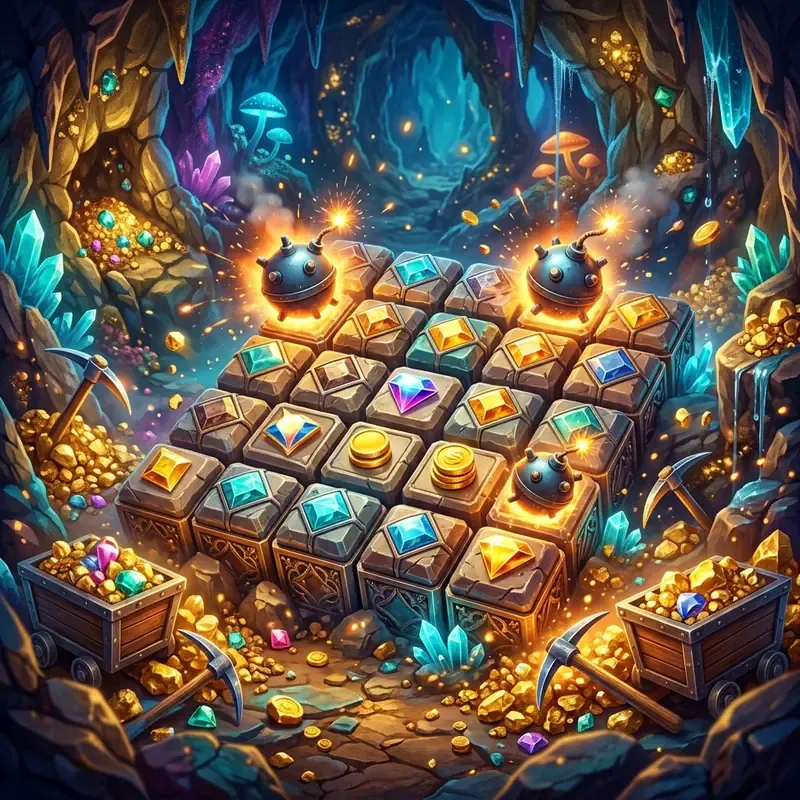
The playing field in the mines game is a grid whose size ranges from 3×3 (9 cells) to 9×9 (81 cells), although the most popular standard remains the 5×5 board with 25 cells. On larger grids such as 7×7 or 9×9, the multiplier increment per safe tile is smaller, yet the overall chance of hitting a mine on the first click falls proportionally. The configuration is fixed before the round starts: all tiles are closed, and a Provably Fair algorithm distributes the pre-selected number of hidden mines across the board.

Every click on a closed cell leads to one of two outcomes:

  1. A safe tile opens: a green gem or coin appears, the round multiplier grows, and the Cash Out button becomes active for collecting the money.
  2. A hidden mine opens: an explosion occurs, the round ends instantly, and the staked amount is lost.

Mathematically, the chance of a successful click changes with every step. If a 5×5 field holds 3 mines, the probability of opening a safe cell on the first step is 22/25, that is 88%. If the first tile was safe, 24 cells and 3 mines remain, so the probability on the second step drops to 21/24 (87.5%). In formal terms, the single-step risk always equals remaining mines ÷ remaining unopened cells. Which means avoiding hidden mines becomes mathematically harder with every tile you open, not easier, even though the board looks emptier.

The Playing Field, Safe Tiles and

Multipliers and the Cash Out Moment

The multiplier in mines casino grows exponentially as the player reveals more safe tiles without touching a mine. The size of the coefficient depends directly on the initial number of mines: the more hidden mines configured in the settings, the higher the starting and subsequent multipliers per revealed cell. A payout bar above the grid usually displays the current and the upcoming multiplier.

The cash out function allows the player to interrupt the round at any moment before an explosion and collect the current win, equal to the base bet multiplied by the achieved coefficient. If the player keeps clicking closed tiles, potential payouts increase, but each new cell raises the risk of losing the entire accumulated sum. Choosing the cash out moment is the key decision element in games mines. Mathematically, hitting a mine resets the accumulated multiplier to zero, so the expected value of the round collapses instantly. There is no partial credit for the six safe tiles you found before the seventh one.

[SCHEME: Mines playing field with annotations. Caption: “Mines Casino Game interface: closed tiles, safe gems, mine counter and the Cash Out button”. Style: clean, graphic]
Purpose: visualise the control elements and the structure of the field before the round starts.
Semantics: image inside a figure block with a visible caption; alt text: “mines casino game”.
Multipliers and the Cash Out Moment

Mines Demo, Free Play and Real-Money Play

Mines demo is a free introductory mode that uses virtual credits to demonstrate the mechanics without financial risk. Moving from free play to real-money betting changes the psychological perception of the process, and it demands strict budget discipline.

The demo version (mines free) fully replicates the mathematical model and the RNG algorithms used in the main mode. So you can study the interface, test different mine counts and watch multiplier dynamics without losing personal funds.

When to Choose Mines Demo

The mines demo mode is best used at the stage of first acquaintance with the product and for testing user settings. Free play lets you understand, at no cost, how risk changes when you place 1, 5, 10 or 20 mines on a 5×5 grid.

Main tasks solved in free play:

  • Getting familiar with the layout of controls, the bet field and the cash out button;
  • Assessing how fast coefficients change with different numbers of hidden mines;
  • Checking how the auto mode works, if the function is available in the specific title;
  • Risk-free understanding of how quickly the probability of an explosion grows when several cells are opened in a row.

Research into the online gambling market shows that simulated and free games are extremely widespread and let users learn the betting mechanic, while quietly blurring the line between play and wagering:

When to Choose Mines Demo. The

«Participation in simulated gambling is widespread and frequently overlaps with real-money betting, blurring the boundary between free and paid play.» (Source: Fiedler, Ante et al., Journal of Gambling Studies, 2024. https://link.springer.com/journal/10899)

Academic data underline the flip side. The absence of real financial risk in demonstration modes can create a false sense of control over random outcomes, and that feeling travels with you into the paid mode.

What Changes When You Bet Real Money

In mines real money mode the key change is the appearance of genuine financial risk, which alters the player's emotions and requires bankroll management. Unlike the demo, where lost virtual credits are restored by reloading the page, every money bet touches the real balance of the user.

Real-money play adds several factors:

  1. Bet levels: the platform sets the minimum and maximum stake per round, for example $0.20–$1,000 in the Hacksaw build.
  2. Psychological pressure: the emotional reaction to a loss often provokes an impulsive urge to “catch up”, known as loss chasing.
  3. The need for self-limitation: a fixed, pre-defined session loss limit becomes essential rather than optional.

Behavioural analysis confirms how strongly monetary transactions reshape engagement patterns:

What Changes When You Bet Real

«Players who made micro-transactions in free games migrated to real-money betting eight times more often than those who spent nothing (OR = 8.16, 95% CI 1.94–34.26).» (Source: Kim, Wohl et al., Journal of Gambling Studies, 2023. https://link.springer.com/journal/10899)

In other words, once real transactions appear, the emotional response to losing intensifies. That is exactly why session-control tools stop being a formality.

Responsible Gaming Disclaimer: Playing Mines for real money involves financial risk and does not guarantee income. Results obtained in the free demo mode (mines demo) are a virtual imitation and do not reflect the future probability of winning with real stakes. Casino play should be treated exclusively as a form of leisure within a pre-set budget. According to regulators such as the MGA (Player Protection Directive 3 of 2018) and the UKGC, controlling time and stake size is a mandatory condition for preventing gambling harm. 18+.

How to Play Mines Online: Step-by-Step Rules

To start playing Mines online, the user selects a bet size, sets the desired number of hidden mines, then opens safe cells one by one and collects the win in time through a locked cash out. The round is strictly sequential and controlled by the player.

Every round in mines online is isolated from the previous ones. The Provably Fair algorithm generates the random mine layout before the first click, and the outcome is committed cryptographically (server seed + client seed + nonce), which makes interference by the operator or the player impossible.

How to Choose the Number of Mines and the Bet Size

The parameters set before the start determine the level of risk and the size of the potential win. In the control menu the player defines two main values: the bet amount and the number of mines.

  • Bet size: the sum risked in the round. It is advisable to choose a value not exceeding 1–2% of the total session budget.
  • Number of mines: from 1 to 24 on the standard 5×5 grid. Choosing 1–3 mines creates a scenario with a high chance of revealing safe tiles but low starting coefficients. Setting 10 or more mines substantially raises the risk of exploding on the very first step, though it delivers extremely high multipliers.

The link between mine count and the probability of a successful first move follows directly from the probability rules: with 1 mine the success chance is 96% (24/25), with 5 mines it is 80% (20/25), and with 15 mines only 40% (10/25).

How to Choose the Number of

How to Open Tiles and Finish the Round

After the bet is confirmed and the round launched, the player starts clicking closed cells on the field.

  1. Clicking a cell: the tile flips. If a gem is underneath, the potential payout is recalculated with the new multiplier.
  2. Making the decision: after every successful reveal the player chooses, click the next closed tile or press Cash Out.
  3. Ending the round: the round finishes either when Cash Out is pressed and the win is credited to the balance, or when a hidden mine is clicked and the stake plus all accumulated coefficients are burned.
[Step-by-step instruction for the Mines Online player]
1. Choose a licensed platform and launch Mines Casino Game.
2. Set the base bet in line with your bankroll.
3. Specify the number of hidden mines on the field, for example 1 to 5 for conservative play.
4. Click closed cells, revealing safe tiles and increasing the multiplier.
5. Press Cash Out before hitting a mine to lock in the profit.
How to Open Tiles and Finish

Provably Fair Checklist: How to Verify Fairness Before You Play

Provably Fair is not a marketing slogan but a verifiable cryptographic procedure. Before a real-money session, run through this short checklist:

  1. Find the fairness section. In the game menu look for “Fairness”, “Provably Fair” or “Verify”. If it is missing, the build is probably running on a certified RNG instead, so check for an eCOGRA or iTech Labs seal.
  2. Check the commitment. Before the round the platform shows the hashed server seed. Save it: the hash must be published before the first click.
  3. Set your own client seed. A genuine implementation lets you edit the client seed manually, which proves the operator cannot know the layout in advance.
  4. Reveal and re-hash. After the round the server seed is disclosed. Run it through any SHA-256 calculator: the result must match the hash you saved.
  5. Reproduce the outcome. Using the server seed + client seed + nonce combination in the provider's verifier, confirm that the mine positions match what you saw on the board.

Editorial experience note. During an editorial audit of informational materials on instant games (a reference to the iGaming Bangladesh project), our team analysed user interaction scenarios with the Mines interface. We recorded that strictly following a self-limitation algorithm, meaning a pre-set loss cap, a fixed number of rounds and a mandatory pause, reduces the frequency of impulsive bets during sessions.

Provably Fair Checklist How to Verify

Mines RTP, Risk and Potential Payout

The return-to-player figure in Mines usually ranges from 95% to 98% depending on the software provider and the settings of the specific casino, and individual builds such as Stake Originals reach 99%. The theoretical return stays constant; only risk and potential payouts scale as the mine count changes.

«The main conclusion regarding Mines: the mathematical advantage of the house remains unchanged under any settings.» (Nadia Farzana Haque, Chief Sports Events Editor, editorial brief)

RTP (Return to Player) shows what percentage of all stakes is mathematically returned to players across an infinitely long series of rounds. The remainder is the house edge. Nothing in the settings menu touches that remainder.

How the Number of Mines Affects RTP and the Multiplier

Changing the number of mines does not change the underlying house edge, but it radically alters volatility and the dispersion of results. At any value of the number of mines, the mathematical expectation of every individual click stays negative for the player, because the edge is embedded in the payout formula itself.

Multiplier growth at different mine counts follows a combinatorial calculation:

  • With 1 mine:the first safe tile brings a minimal increment, roughly 1.01x–1.03x, because the chance of losing is tiny.
  • With 5 mines:the first safe tile raises the coefficient to roughly 1.20x–1.25x.
  • With 10 mines:the first successful cell immediately gives a multiplier of around 1.60x, but the chance of losing the stake on step one is 40%.
How the Number of Mines Affects

An experimental study of how players perceive coefficients showed that standard RTP wording (“average return 96%”) is read far too optimistically. Reframing the same figure as a house-edge message proved measurably more effective:

«The message “the casino keeps 10% of every bet” reduced inflated win expectations far more effectively than the standard RTP 90% formulation (OR > 5).» (Source: Newall et al., Computers in Human Behavior, 2025, experiment with 6,062 participants. https://www.sciencedirect.com/journal/computers-in-human-behavior)

Same arithmetic, different framing, very different reader behaviour.

Why a Large Potential Payout Means High Risk

High potential payouts in the mines game are mathematically offset by an extremely low probability of reaching them. Rapid multiplier growth over several consecutive reveals creates the impression of an easy win, yet the probability of completing a chain of steps falls exponentially. Formally, if the payout grows as e^(a·k) while the survival probability decays as e^(−b·k), the expected value per additional click behaves as e^((a−b)·k), and in a commercial game the decay always dominates.

Calculation example for a 5×5 field with 3 mines:

  • Probability of 1 successful step: 22/25 = 88.0%
  • Probability of 2 successful steps in a row: (22/25) × (21/24) = 77.0%
  • Probability of 5 successful steps in a row: (22/25) × (21/24) × (20/23) × (19/22) × (18/21) = 51.6%
  • Probability of 10 successful steps in a row: falls below 20%.

Example for a 3×3 grid with 1 mine: the probability of opening the first safe cell is 8/9 (88.8%), two in a row gives (8/9) × (7/8) = 77.7%, three in a row 66.6%. Understanding the difference between grid sizes helps you select volatility more precisely. A 3×3 board with one mine feels “safe” per click yet offers only nine cells of runway, while a 9×9 board with three mines produces long, low-paying chains that eat time rather than balance.

The subjective pull of these near-completions is not merely anecdotal:

Why a Large Potential Payout Means

«Near-win situations activate neural reward patterns (enhanced FRN and P300), creating an illusion of proximity to success and encouraging continued play.» (Source: systematic review of the neurophysiological correlates of near-wins, Journal of Gambling Studies, 2024. https://link.springer.com/journal/10899)

This is exactly why the feeling that “one more tile” was almost safe is a cognitive artefact, not information about the next round.

The table below illustrates how the level of risk, the starting multiplier and the recommended collection moments change across different game scenarios:

Number of mines (M)Safe cells (25 − M)Success chance on step 1Coefficient for the 3rd safe tile (indicative)Risk profileRecommended Cash Out moment
1–3 mines22–2488% – 96%1.15x – 1.35xLow volatilityAfter 2–4 opened cells
5–8 mines17–2068% – 80%1.80x – 3.20xMedium volatilityAfter 1–3 opened cells
10–15 mines10–1540% – 60%5.00x – 15.00xHigh volatilityAfter 1–2 opened cells

Conclusion from the table: by choosing configurations with many mines, the player accepts that most rounds will end in an early explosion, and that the overall result depends on rare successful streaks. Those streaks look glorious in a screenshot and mediocre in a monthly total.

Mines Strategy: How to Manage Risk During Play

No strategy in Mines can change the RTP built in by the developers or guarantee a mathematical win. What a systematic approach does give you is control over bet size and protection from emotional decisions. Risk management here boils down to bankroll discipline and control over exit points.

Player communities frequently discuss staking systems such as Martingale, or the search for hidden regularities known as pattern hunting. Probability theory and the available research confirm their long-run ineffectiveness.

The “1:1 Ratio” Strategy (Minimum Risk)

A variety of conservative play popular on Stake- and Spribe-powered platforms. The essence of the method:

  • The settings are fixed at exactly 1 mine on a 5×5 field, so 24 safe cells out of 25.
  • Per round the player opens exactly 1 cell (success chance 96%, coefficient ≈1.03x) and immediately presses Cash Out.
  • The process is repeated, often in continuous or auto mode.
  • Mathematical nuance: despite frequent small wins, and 96% of rounds do win, a single loss wipes out the profit accumulated across roughly the previous 24 successful rounds. The strategy suits grinding wagering requirements (bonus playthrough) and does not alter the final house edge.
The 1 1 Ratio Strategy Minimum

The Strategy with Fewer Mines and Early Cash Out

The conservative approach in mines strategy is based on selecting a minimal number of dangerous objects, usually 1–3 mines, and locking profit on the first steps of the round.

The essence of the low-risk model, sometimes called low risk play:

  • 1, 2 or 3 mines are set on the 5×5 grid;
  • The player opens between 1 and 3 safe tiles per round;
  • Cash out is pressed once a small fixed increment is reached, for example 1.10x–1.25x;
  • The bet size stays constant, with no progression after losses.

Such an approach reduces the volatility of results and lengthens the session. It does not make the session profitable on average, and honest coverage should say so out loud.

The Strategy with Fewer Mines and

«The use of low-volatility scenarios with strict limits helps players control expenditure better and avoid large one-off losses.» (Source: Delfabbro, Parke & Catania, Journal of Gambling Studies, 2024. https://link.springer.com/journal/10899)

The “More Mines” Approach and Its Cost

The opposite configuration, with 10, 15 or 20 mines, is chosen by players hunting three- and four-digit multipliers. Raising the mine count does increase the payout per safe tile, and it also raises variance sharply: with 15 mines, 60% of rounds end on the very first click. This profile is only defensible with micro-stakes and a hard session cap, because the distribution of outcomes is dominated by long losing streaks punctuated by rare spikes.

Why You Should Not Hunt Patterns or Raise Bets After a Loss

Attempts to find “patterns” on the field, or to double bets after every loss with the Martingale system, are mathematically meaningless and increase the risk of a fast wipe-out.

  1. Independence of rounds: Mines uses an RNG and a Provably Fair commitment scheme. The layout of hidden mines in a new round is unrelated to where they were in the previous one. Clicking specific “favourite” cells does not change the probability of success by a single percentage point.
  2. The danger of Martingale. Doubling the stake after each explosion is not a low-risk method, contrary to what some strategy pages claim. The arithmetic is unforgiving: with a base bet of 1 unit, a losing streak requires cumulative stakes of 1 + 2 + 4 + 8 + 16 + 32 + 64 = 127 units to survive seven consecutive losses, and the eighth attempt alone demands 128 units. On a 5×5 board with 5 mines and a two-tile target, the chance of a seven-loss streak within a few hundred rounds is not marginal, it is routine. Combined with table maximums and a finite bankroll, geometric progression converts a series of ordinary losses into total ruin. Corrected classification: Martingale is a high-risk system, not a “low risk play”.
  3. No system changes the edge. A fixed house edge makes the expected value of every wager negative; altering stake size only changes variance and the speed of ruin, never the average outcome.
Why You Should Not Hunt Patterns

Expert Fact Check: Mathematical audits by independent laboratories (eCOGRA, iTech Labs) and independent expert research confirm one thing clearly: no betting strategy can change the base RTP of Mines. The RNG algorithm ensures fully random mine distribution. Any claims about the existence of “hacking schemes”, “winning templates” or “guaranteed algorithms” are misleading. Strategies only help to organise the management of your own budget.

Where to Play Mines Casino: Access, Bonuses and the Mobile Version

Access to Mines casino runs through desktop and mobile browsers as well as dedicated casino applications, with a free demo mode, real-money betting and bonus offers on the table. Before starting, it is worth studying the available platforms and the terms of any promotion, line by line.

Modern providers, for example Spribe with their popular version of Mines and Hacksaw Gaming with the selectable-grid build, develop their software on HTML5. That keeps performance stable on almost any device without a separate client.

How to Access Mines Casino Game and Use a Bonus

Access to the mines casino game normally requires a registered account on an operator platform. For a first look, registration is often unnecessary, since the demo mode is available directly on media sites and game catalogues.

When using welcome bonuses or free spins for instant games, specific operator conditions apply:

  • Wagering contribution:unlike classic slots, bets in Mines and other arcade games are often counted towards the wagering requirement at a reduced rate, sometimes only 5–10% of the stake.
  • Maximum bet restrictions:while a bonus is active, the platform may cap the maximum bet per round.
  • Cash out limits:bonus terms may include a ceiling on the maximum amount withdrawable from bonus funds.
How to Access Mines Casino Game

Qualitative research into user behaviour shows that promotional offers frequently push players into sessions they had not planned:

«Study participants described bonuses as “gifts” that encouraged more frequent play: “Sometimes they give bonuses, well, I'll play a little more.”» (Source: Ghelfi, Marchesi et al., Current Psychology, 2026. https://link.springer.com/journal/12144)

Experts therefore recommend studying the wagering rules in detail before activating any promo code, and comparing the terms published by different iGaming platforms rather than relying on headline bonus figures alone. A 300% offer with a 60x rollover is often worse than a modest 50% with 20x.

Mines Mobile and Mines Download: Playing on a Phone

Mines mobile is the version of the game adapted for smartphones and tablets on iOS and Android. Downloading separate files, the thing users search for as mines download, is usually unnecessary, because PWA and HTML5 web versions fully replicate desktop functionality.

Features of Mines on mobile devices:

  • Touch interface:the size of the cells and of the Cash Out button is increased for comfortable finger taps on small screens.
  • Performance:optimised code ensures fast loading even on unstable mobile connections.
  • Access format:the user can choose between the browser version (PWA) and the operator's official application.
Mines Mobile and Mines Download Playing

Step-by-Step Guide: How to Install Mines on Android and iOS

Because the original Mines Casino Game runs inside licensed casino platforms, the game developers do not publish a standalone app in Google Play or the App Store. Installation is performed through the mobile version of the site:

  1. For Android (APK / PWA): open the chosen casino site in Chrome or Firefox, open the browser menu (three dots), then tap “Add to Home screen” or “Install app”. The PWA installs in about five seconds and requires no system-level permissions.
  2. For iOS (iPhone/iPad): open the site in Safari, tap the “Share” button (square with an upward arrow), then choose “Add to Home Screen”.
  3. Launch the created shortcut, log in, search for “Mines” in the game lobby and start playing, in demo mode first.
Step-by-Step Guide How to Install Mines

APK safety warning. Do not install .apk files offered by third-party aggregators, Telegram channels or “Mines earning app” landing pages. Such builds sit outside the app-store review process, frequently request excessive permissions (SMS, accessibility services, screen overlay) and are a known vector for banking-credential theft. Use only the PWA created from the operator's own domain, or an application linked from the licensed operator's site, keep it updated, and enable two-factor authentication where available. Any page promising guaranteed “earnings” from Mines is a marketing claim, not a description of the game's mathematics.

Reviews in the psychology of mobile gambling warn about the specific hazard of always-available play:

«The smartphone environment interacts with reinforcement schedules in gambling, accelerating the formation of maladaptive behavioural patterns and increasing the risk of gambling disorder.» (Source: review of mobile gambling psychology, cited by NIDA, 2025. https://nida.nih.gov/research-topics/gambling)

Because a phone lowers the barrier to entry and enables frequent short sessions throughout the day, playing from a mobile device requires heightened attention to personal time limits. Five minutes in a queue, five more on a bus, and the session count quietly triples.

This section is general information, not legal advice. Gambling legislation changes, is interpreted differently by courts and regulators, and varies by jurisdiction. Consult a qualified lawyer in your country before making any decisions.

The Regulatory Picture in Bangladesh

  • Base legislation. Gambling in Bangladesh is governed primarily by the Public Gambling Act, 1867, a colonial-era statute that prohibits keeping and operating common gaming houses and penalises participation. The Act predates the internet and does not describe online instant-win games explicitly, which is precisely why the online segment sits in a legal grey zone rather than in a clearly permitted one.
  • No domestic licensing regime. There is no local licence for online casino operations in Bangladesh. Any real-money platform available to Bangladeshi users is therefore licensed offshore (Curaçao, Anjouan, Malta, Isle of Man) and is not supervised by a Bangladeshi authority. Player-protection guarantees, dispute resolution and payout obligations depend entirely on that foreign licence.
  • Access restrictions. Regulators and telecom authorities periodically order the blocking of gambling domains and related payment channels. Sites may become unreachable without notice, and access via mirrors or VPNs creates additional account-verification and fund-recovery risks.
  • Payments and mobile financial services. Using mobile financial services (bKash, Nagad, Rocket) or cards for gambling-related transfers carries real practical risks: transactions may be rejected, accounts frozen for suspected prohibited use, and funds routed through informal “agents” can be lost with no recourse. Foreign-exchange rules also restrict outward remittances for such purposes. Never send money to a private “agent” promising to top up a casino balance.
  • Age. Regardless of jurisdiction, these products are for adults only: 18+, or 21+ on some social-casino platforms.

Practical takeaway for readers in Bangladesh: the safest and fully lawful way to experience Mines mechanics is the free demo mode with virtual credits, which involves no deposits, no payment rails and no financial exposure.

The Regulatory Picture in Bangladesh

Sports Media vs Casino Operator: Where the Line Runs

Readers often ask why a sports portal analyses arcade games at all. Fair question. The answer lies in the structure of the industry, and in the difference between an information publisher and a gambling operator:

Sports / iGaming media (this resource)Casino operator
FunctionPublishes reviews, mathematics, rules, risk warningsOffers games, accepts wagers
Money flowDoes not accept deposits or hold player fundsHolds balances, processes deposits and withdrawals
LicenceNot required for editorial content; no gambling licence heldGambling licence from a regulator required
InterestReader understanding, factual accuracy, harm reductionCommercial margin from the house edge
ResponsibilityAccuracy of information, disclosure of risksPlayer protection, KYC/AML, payouts

Sports betting and instant games also differ fundamentally. In sports betting, part of the outcome depends on informational analysis: form, injuries, line movement, and the operator's margin is embedded in the odds. In instant games such as Mines, there is nothing to analyse. Mine placement is generated randomly and committed cryptographically before your first click, so no research, no “reading of the board” and no historical data can improve your expected value. That asymmetry is the main reason our editorial desk treats instant games as entertainment content rather than as an analytical betting market.

Sports betting and instant games also

Safe Play in Mines: What to Check Before Betting

Safe play in Mines rests on three habits: setting financial limits in advance, verifying the legal status of the platform, and refusing to chase losses. Basic financial hygiene reduces the likelihood of gambling-related problems, even if it never removes it.

Before placing a first real-money bet, the player should audit both the chosen platform and their own capacity.

Limits on Bets and Control of the Gambling Budget

Disclaimer: the information is general in nature and does not replace consultation with a specialist. If you notice signs of gambling addiction, contact a psychological-support helpline.

Budget control is the basic element of safe interaction with high-tempo games. Because rounds in Mines resolve in seconds, a player can place dozens of bets in a few minutes without noticing the total.

Methods of budget control:

  1. Fixed session limit (Stop-Loss): a pre-determined sum the player is prepared to lose in an unsuccessful session. When the threshold is reached, play stops.
  2. Fixed profit target (Stop-Win): a pre-set win threshold, for example +20% to the bankroll, at which the session ends and profit is locked in.
  3. Session time limit: a 15 to 30 minute timer that prevents loss of concentration.
  4. Stake sizing: no more than 1–2% of the session bankroll per round, with no progression after losses.
  5. Deposit-free cool-off: never re-deposit inside the same session; wait at least until the next day.

Behavioural-tracking research on real player data demonstrates how powerful an enforced interruption can be:

Budget control is the basic element

«After a mandatory 60-minute break was introduced, the share of players who stopped depositing on the same day rose from 27% to 68%.» (Source: player behavioural-tracking study, Journal of Gambling Studies, 2023. https://link.springer.com/journal/10899)

Mandatory pauses and self-limitation tools therefore substantially reduce the probability of irrational repeat deposits. An hour of distance does what willpower alone rarely manages.

Bonus Terms and Available In-Game Options

In-game safety settings and platform functions let the user shape the process and constrain risk.

What to check before starting:

  • Availability of self-exclusion:the ability to block access to the account for a defined period.
  • Automatic deposit limits:daily, weekly or monthly caps on funding the account.
  • In-game options:switching off auto-play and turbo mode so that every cell choice is made deliberately and without haste.
  • Transparency of bonus rules:making sure the wagering terms do not force excessively high bets in the mines game.
  • Licence and audit trail:the regulator's licence number, the RNG certificate (eCOGRA, iTech Labs) and a working Provably Fair verifier.
Bonus Terms and Available In-Game Options

The effectiveness of self-exclusion is strengthened when marketing pressure is removed as well:

«An extended nine-month ban on commercial marketing after self-exclusion significantly reduced player deposits both during the ban and for three months after it ended.» (Source: Harm Reduction Journal, 2025. https://harmreductionjournal.biomedcentral.com)

Following these rules does not eliminate risk. Still, the available evidence indicates that it materially reduces it, keeping Mines closer to a controlled form of entertainment and leaving financial exposure within limits the user has consciously chosen. A negative expected value remains a mathematical property of the game itself, and no checklist rewrites it.

Pre-Play Safety Checklist

  • The platform's licence is verifiable and the operator accepts players from your jurisdiction.
  • The provider and RTP of the specific Mines build are stated (Spribe ≈97%, Hacksaw 98%, Stake Originals 98–99%).
  • Provably Fair verification or an independent RNG certificate is available.
  • Deposit, loss and session-time limits are set before the first bet.
  • Self-exclusion and reality-check tools exist in the account settings.
  • Bonus terms are read: wagering contribution, max bet, withdrawal ceiling.
  • Auto-play and turbo mode are switched off.
  • No third-party APK is installed; the app comes from the operator's own domain.
  • You have tested the mechanic in mines demo first.
  • You are of legal age and playing with money you can afford to lose.
Pre-Play Safety Checklist. - The platform's

FAQ: Mines Casino Game

Editorial note: this material was prepared and fact-checked by the iGaming Bangladesh sports editorial desk. Sources are cited inline with publication and year. If you or someone close to you shows signs of gambling harm, such as chasing losses, borrowing to play or hiding play time, stop playing and contact a psychological-support helpline. 18+.